




California Off the Clock Work Laws
Every year, American workers lose billions of dollars to unpaid labor, much of it quietly slipping away during off the clock tasks. Most people assume their salary or hourly wage covers every minute spent working.
That is not how California sees it. State law treats off the clock work as a serious threat to fair pay and has built some of the toughest worker protections in the country to make sure not a single earned dollar is left on the table.
What Are Off the Clock Work Laws?
Off the clock work laws protect employees from working without proper compensation, addressing situations where workers perform job-related tasks outside their officially scheduled hours. These laws are critical in preventing wage theft and ensuring fair treatment in California’s diverse workplace environments.
Legal Definition of Off the Clock Work
Off the clock work represents any labor performed by an employee that occurs outside their standard paid work hours but still benefits the employer. According to the U.S. Department of Labor, this can include various activities such as:
- Preparing work equipment before scheduled shifts
- Completing administrative tasks after official work hours
- Responding to work-related communications during personal time
- Participating in mandatory training or meetings outside regular work schedules
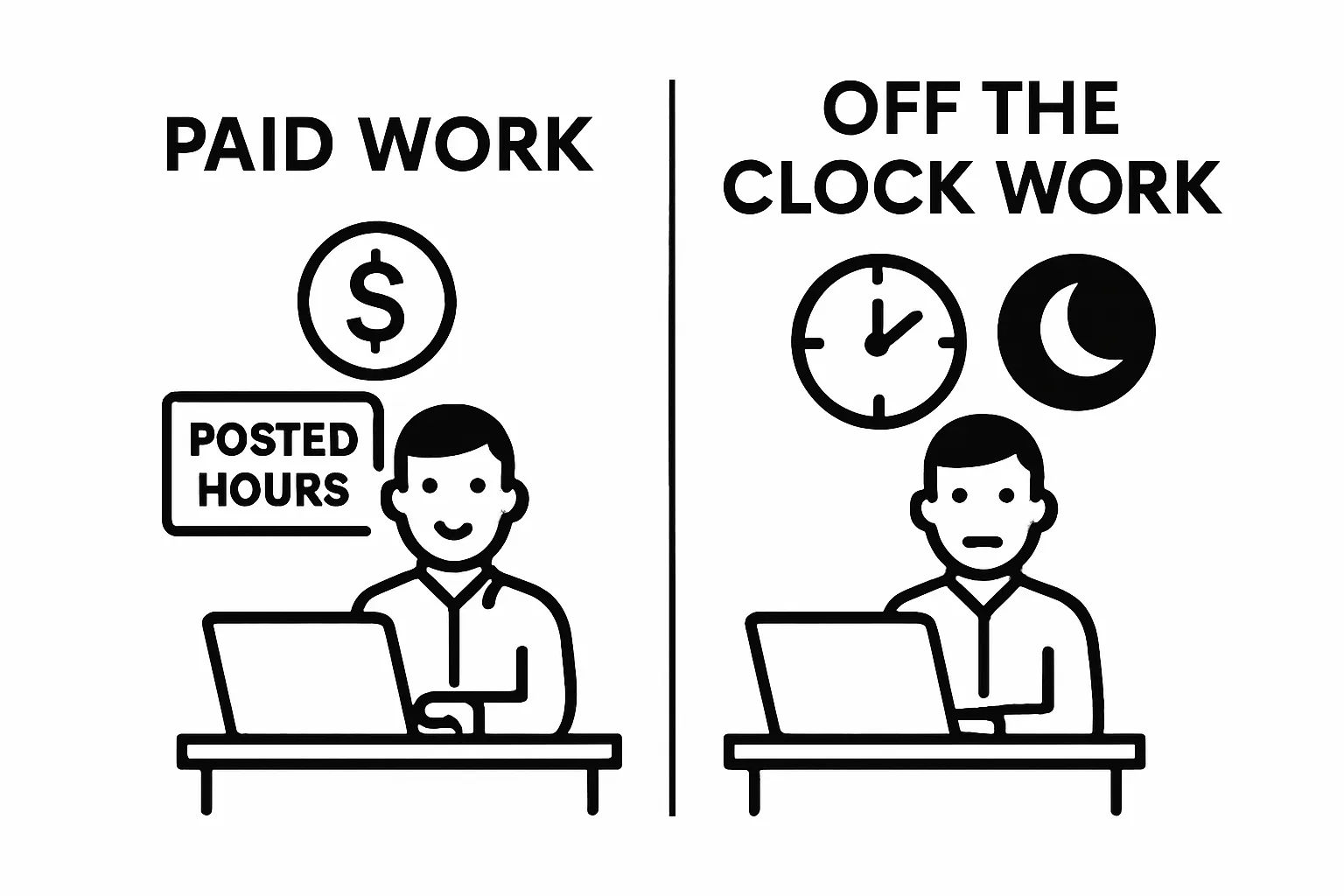
Scope and Employee Protections
California labor laws go beyond federal standards in protecting workers from unpaid labor. Employers are legally required to compensate employees for all work performed, regardless of whether it was explicitly authorized or occurred outside standard work hours.
Our guide on overtime disputes provides additional insights into workers’ compensation rights.
The core principle is straightforward: If an employer knows or should have known that work was performed, they must pay for that time. This means even unauthorized overtime or preparatory work must be compensated at appropriate wage rates.
Why Off the Clock Work Laws Matter for Employees
Off the clock work laws are fundamental protections that safeguard workers from economic exploitation and ensure fair compensation for their time and effort. These legal provisions are more than just regulatory requirements they represent a critical mechanism for maintaining workplace dignity and preventing systemic wage theft.
Financial Impact on Workers
Unpaid work can significantly lower an employee’s total earnings. According to research from the Economic Policy Institute, workers lose billions of dollars annually through uncompensated labor. This financial drain disproportionately affects low wage workers who often lack the resources to challenge unfair employment practices.
The consequences extend beyond immediate monetary loss:
- Reduced hourly effective wage rates
- Potential long term career development impediments
- Increased financial stress and economic instability
Workplace Power Dynamics
Off the clock work laws help rebalance power dynamics between employers and employees. By mandating compensation for all work performed, these regulations prevent employers from extracting free labor through implicit or explicit pressure.
These laws recognize that work extends beyond traditional clock punching. Modern workplace interactions frequently blur lines between professional and personal time, especially with technologies like smartphones enabling constant communication.
Legal frameworks ensure employees are not economically penalized for being accessible and responsive to work demands outside standard hours.
Off the clock work laws represent a fundamental worker protection mechanism that acknowledges human labor as a valuable commodity deserving fair, transparent compensation.

Key Concepts Behind Wage Theft and Unpaid Wages
Wage theft represents a systematic problem where employers deliberately or negligently fail to compensate workers for their complete labor. Understanding the fundamental mechanisms of wage theft is crucial for employees to protect their economic interests and recognize potential workplace violations.
Defining Wage Theft Mechanisms
Wage theft encompasses multiple forms of compensation denial. According to the National Employment Law Project, these violations can occur through various subtle and explicit strategies:
- Refusing to pay minimum wage
- Neglecting overtime compensation
- Forcing employees to work off the clock
- Manipulating timekeeping records
- Misclassifying workers as independent contractors
Legal and Economic Implications
The economic impact of wage theft extends far beyond individual worker experiences. Employers who engage in systematic wage theft create unfair competitive advantages by reducing labor costs at the expense of worker compensation. Our comprehensive guide on wage theft claims provides workers with detailed strategies for addressing these violations.
Wage theft disproportionately affects vulnerable worker populations, including immigrants, young workers, and individuals in low wage industries.
Here is a table summarizing key forms of wage theft described in the article and their typical impacts on employees in California.
| Type of Wage Theft | Description | Example Impact on Employees |
|---|---|---|
| Minimum Wage Violations | Paying less than the legal minimum wage | Lowered total income, increased hardship |
| Overtime Violations | Not compensating for hours worked beyond standard limits | Lost overtime pay, reduced effective wages |
| Off the Clock Work | Requiring work outside of paid hours without compensation | Unpaid labor, loss of earnings |
| Timekeeping Manipulation | Falsifying or altering employee time records | Unrecorded hours, diminished paychecks |
| Worker Misclassification | Labeling employees as independent contractors to avoid benefits | Loss of legal protections and compensation |
These workers often lack the resources or legal knowledge to challenge improper compensation practices, making systemic protections critically important for maintaining economic fairness and worker dignity.
How Off the Clock Work Laws Protect Workers
Off the clock work laws serve as a critical shield protecting employees from economic exploitation, establishing clear legal boundaries that prevent employers from extracting unpaid labor.
Comprehensive Legal Safeguards
These laws create robust mechanisms to prevent workplace abuse by mandating comprehensive compensation standards. According to the U.S. Department of Labor, workers are entitled to payment for all time spent performing job duties, regardless of whether the work was formally authorized.
The protection framework includes:
- Mandatory compensation for preparatory and concluding work activities
- Compensation for required training and mandatory meetings
- Protection against informal pressure to work without pay
- Legal recourse for recovering unpaid wages
Real-World Implications of These Laws in California
Off the clock work laws in California represent a powerful legal framework designed to protect workers across diverse industries, addressing nuanced workplace scenarios that extend far beyond traditional compensation models.
These regulations create meaningful protections that reflect the complex realities of modern employment environments.
Industry-Specific Challenges
Different sectors face unique challenges in implementing off the clock work protections. According to research from the California Labor Commissioner’s Office, industries like technology, hospitality, and service sectors frequently encounter complex compensation scenarios. The most prevalent off the clock work challenges include:
- Technology workers expected to be perpetually available via email
- Restaurant staff performing side work before and after shifts
- Retail employees required to conduct inventory or store preparation unpaid
- Healthcare workers completing patient documentation outside scheduled hours
The following table compares how off the clock work challenges manifest in different industries:
| Industry | Common Off the Clock Work Issues | Example Activities |
|---|---|---|
| Technology | Expectation to be constantly available | Responding to emails after hours |
| Hospitality | Unpaid pre/post-shift tasks | Restaurant staff setting up before/after scheduled time |
| Retail | Additional work before/after shift hours | Inventory checks, store preparation without pay |
| Healthcare | Documenting work outside scheduled shifts | Completing patient files or paperwork after clocking out |
Take Control of Unpaid Work and Protect Your Rights in California
If you are feeling frustrated by uncompensated off the clock work or worried that your employer may be violating your rights, you are not alone. Many California workers are forced to perform tasks without proper pay, encountering wage theft and unfair workplace demands.
You have the power to challenge wage theft and claim the compensation you deserve. Use our free legal resources to get clear guidance on unpaid work situations, calculate your owed wages, or learn about wage theft claims.

Take the first step. Call California Labor Law at 1-866-355-9991 today for a free off the clock rights consultation. We offer quick, confidential help with your off the clock work questions.
Frequently Asked Questions
What constitutes off the clock work?
Off the clock work includes any job-related tasks performed outside of officially scheduled hours, such as preparing equipment, completing tasks after hours, or attending mandatory training.
Are employees entitled to payment for off the clock work?
Yes, employees are legally entitled to compensation for all work performed, including off the clock activities unless they explicitly waived their rights or the work was authorized.
How do off the clock work laws protect employees from wage theft?
Off the clock work laws prevent wage theft by mandating that employers compensate employees for all hours worked, ensuring that even unauthorized overtime or preparatory work isn’t taken advantage of.
What legal recourse do employees have for unpaid off the clock work?
Employees can file wage claims, participate in class action lawsuits, and seek administrative interventions through state labor boards for unpaid off the clock work in California.