




How Many Days Can an Employer Legally Delay Your Paycheck in California?
Unpaid wages and wage theft are all too common for California workers in the service industry. Strict wage payment rules protect employees, but many still find themselves waiting past payday or facing sudden terminations without proper compensation.
Understanding the exact deadlines and legal remedies can empower you to demand your rights and recover what is owed. This guide sheds light on the steps you can take and the penalties employers face for violating California wage laws.
California wage payment deadlines and rules
In California, employers must adhere to strict wage payment regulations designed to protect workers from delayed compensation. Wage payment guidelines mandate specific timelines that employers must follow when compensating their employees.
The primary rules for wage payments in California include:
- Wages must be paid at least twice per calendar month
- Payments must occur on designated, consistent paydays
- First half of month (1st-15th) wages must be paid by the 26th
- Second half of month (16th-month end) wages must be paid by the 10th of the next month
- Overtime wages require payment by the next regular payday
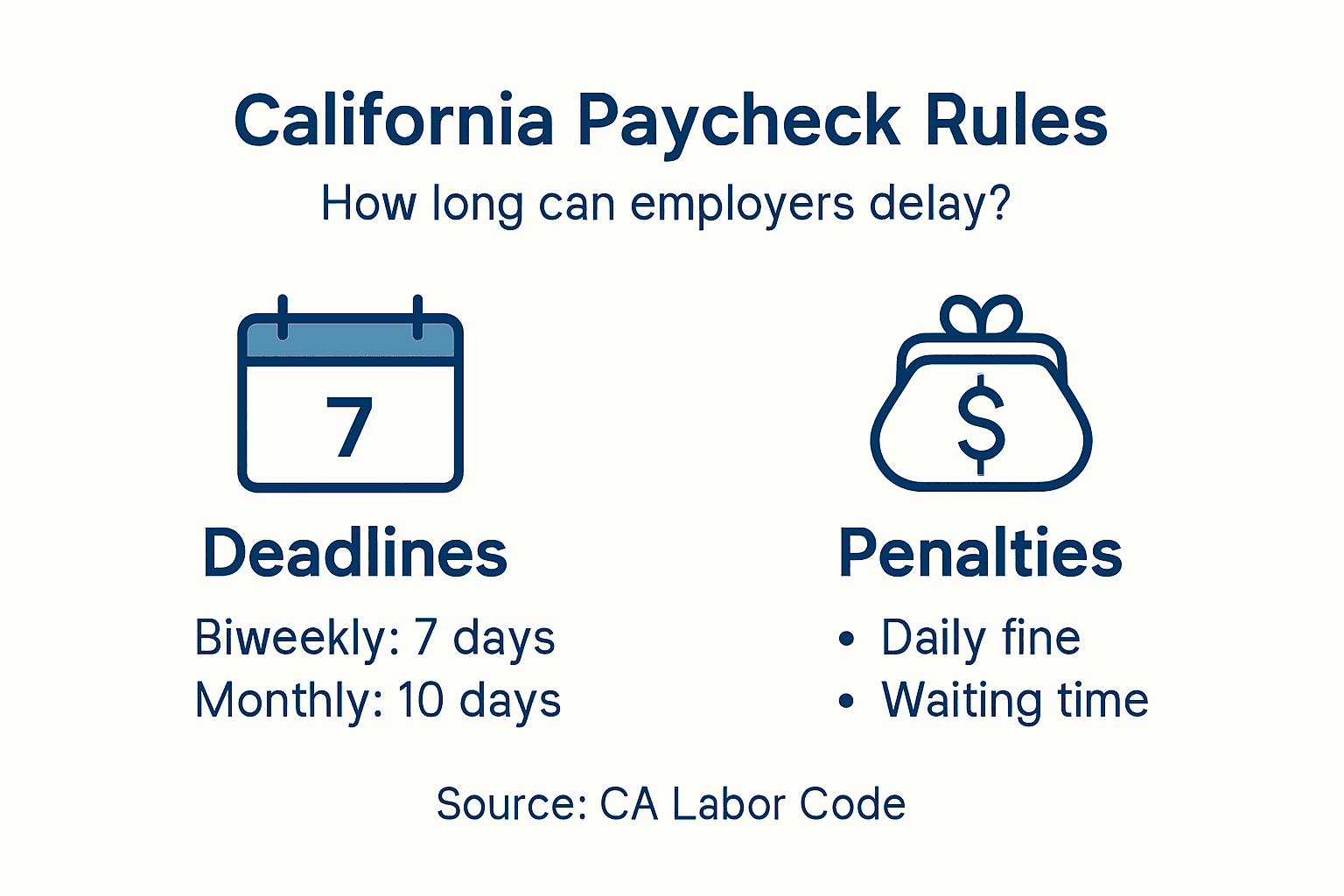
Different pay schedules have unique requirements. For weekly or biweekly pay periods, employers must distribute wages within seven days after the pay period concludes. Immediate payment becomes mandatory when an employee is discharged or voluntarily terminates their employment.
Employers are legally obligated to post clear notices about paydays, including specific payment times and locations. These notices help ensure transparency and give employees predictable wage expectations. Specialized industries like farm labor have additional nuanced payment regulations that require careful attention.
Pro tip: Always keep detailed records of your work hours and verify your paystubs match the exact hours worked to protect your wage rights.
Here’s a comparison of pay schedule rules and payment timelines for California employees:
| Pay Schedule Type | Payment Deadline | Applicable Circumstances | Special Requirement |
|---|---|---|---|
| Semi-monthly | 1st half by 26th, 2nd by 10th next month | Most workplaces | Must occur regularly |
| Weekly/Biweekly | Within 7 days after pay period end | Hourly and shift workers | Include overtime in next payday |
| Termination/Resignation | Immediate or within 72 hours | Anytime employment ends | Immediate payment required |
Types of late wage payments and who is covered
California’s labor laws provide comprehensive protections for employees across various wage payment scenarios. Late payment regulations cover multiple wage types and employment categories, ensuring workers receive timely compensation regardless of their employment status.
The types of wage payments covered under California law include:
- Regular hourly and salaried wages
- Overtime compensation
- Vacation and paid time off
- Final wages upon employment termination
- Commissions and performance-based payments
- Supplemental wages like bonuses
Employees protected by these regulations encompass a broad range of workers, including:
- Full-time employees
- Part-time workers
- Temporary and seasonal employees
- Contract workers
- At-will employees
- Workers in specialized industries (motion picture, oil drilling)
Specific payment timelines vary depending on the wage type and employment circumstance. For instance, final wages must be paid immediately upon discharge or within 72 hours if an employee quits without prior notice. Overtime wages require payment by the next regular payday, while standard wages must be distributed at least twice per month on predetermined dates.
Penalties for late payments can be significant, with employers potentially facing financial sanctions for consistently failing to meet wage payment deadlines. These regulations aim to protect workers from potential wage theft and ensure consistent, predictable compensation.
Pro tip: Maintain detailed employment records and track your wage payments carefully to quickly identify and address any potential payment discrepancies.
Penalties for missed or late paychecks
California’s labor laws impose strict financial consequences for employers who fail to pay wages on time. Late payment penalties are designed to protect workers and ensure timely compensation across all employment sectors.
The primary penalties for missed or late paychecks include:
- Daily penalties for each workday wages remain unpaid
- Waiting time penalties for involuntary terminations
- Civil penalties payable to the state
- Potential recovery of penalties through wage claims
- Legal costs and potential litigation expenses
- Penalties calculated based on employee’s daily rate
Waiting time penalties are particularly significant. When an employee is involuntarily terminated, employers must pay all wages immediately or face escalating financial sanctions. These penalties can accumulate quickly, with employers potentially owing a full day’s wages for each day of delay, up to a maximum limit determined by the employee’s regular daily rate.
Employees have multiple avenues to recover unpaid wages, including filing claims with the Labor Commissioner’s Office or pursuing action under the Private Attorneys General Act.
The legal system provides robust mechanisms to ensure workers receive timely compensation and employers face meaningful consequences for wage payment violations.
Pro tip: Document every instance of late payment meticulously, including dates and specific wage amounts, to strengthen your potential legal claim.
Employee rights and options for recovery
California provides robust legal mechanisms for workers to address wage payment violations and recover unpaid compensation. Wage claim procedures offer employees multiple pathways to assert their rights and seek financial recovery.
Employees have several critical options for addressing late or missed paychecks:
- File a wage claim with the Labor Commissioner’s Office
- Pursue civil litigation against the employer
- Submit a complaint through the Division of Labor Standards Enforcement
- Request statutory penalties for continued wage violations
- Seek recovery of unpaid wages plus potential interest
- Challenge employer non-payment through administrative hearings
Legal protections are comprehensive and designed to shield workers from potential retaliation. When an employee files a wage claim, the state provides safeguards to prevent employers from taking punitive actions like termination or demotion. These protections ensure workers can confidently pursue their rightful compensation without fear of workplace consequences.
The wage recovery process typically involves submitting detailed documentation, including pay stubs, employment contracts, and records of communication with the employer.
The Labor Commissioner’s Office investigates claims and can order employers to pay outstanding wages, penalties, and potential legal costs. This system creates a powerful deterrent against wage theft and ensures employees have meaningful recourse when their compensation rights are violated.
Pro tip: Collect and preserve all employment documentation, including emails, pay stubs, and communication records, to build a strong case for wage recovery.
The following table outlines common avenues for recovering unpaid wages in California and their main features:
| Recovery Method | Action Required | Outcome Possibilities | Worker Protections |
|---|---|---|---|
| Wage Claim (Labor Commissioner) | File official claim | Order for employer to pay | Protection against retaliation |
| Civil Litigation | Hire attorney, sue employer | Wage recovery, potential penalties | Shielded from adverse employment |
| Administrative Complaint | Submit through enforcement | Investigations, mandatory payment | Confidential until resolved |
Steps to take if an employer does not pay wages
California workers have multiple strategic options when confronting wage payment issues. Wage claim procedures offer comprehensive pathways for recovering unpaid compensation and addressing employer non-compliance.
The recommended steps for addressing unpaid wages include:
- Document all communication with the employer
- Calculate the total amount of unpaid wages
- Gather supporting evidence like pay stubs and work records
- Send a formal written demand letter requesting payment
- File a wage claim with the Labor Commissioner’s Office
- Consider consulting with an employment law attorney
- Prepare for potential administrative hearings
Initial communication is crucial. Workers should first attempt to resolve the issue directly with their employer through written communication, maintaining a professional and factual tone. Detailed documentation of all interactions creates a strong foundation for potential legal action.
If direct communication fails, employees can file a formal wage claim with the Division of Labor Standards Enforcement. The agency will investigate the claim, potentially schedule a hearing, and can order employers to pay outstanding wages, penalties, and legal costs. Employees are protected from retaliation during this process, ensuring they can confidently pursue their rightful compensation.
Pro tip: Keep copies of all employment documents, emails, and communication records in a secure, organized system to strengthen your potential wage recovery claim.
Protect Your Right to Timely Paychecks in California
Delayed or missed paychecks can cause serious financial stress and uncertainty. If you are struggling with late wage payments or worried about your employer’s failure to pay, you are not alone.
Understanding your rights and the legal tools available is critical to stopping paycheck delays and recovering the compensation you deserve.
Visit California Labor Law to access detailed legal guides, use helpful calculators to estimate what you are owed, and discover how to confidently file a wage claim or pursue other recovery methods. Take control today by calling 1-866-355-9991 for a free paycheck delay consultation and stop employer wage violations before they escalate.
Frequently Asked Questions
How often must employers in California pay their employees?
Employers in California are required to pay their employees at least twice per calendar month on designated paydays.
What are the deadlines for paying wages in California?
Wages for the first half of the month must be paid by the 26th, and wages for the second half must be paid by the 10th of the following month.
What happens if an employer fails to pay wages on time in California?
Employers may face penalties for each day wages remain unpaid, as well as waiting time penalties for involuntary terminations.
Can employees take action if their wages are not paid on time?
Yes, employees can file a wage claim with the Labor Commissioner’s Office or pursue civil litigation against their employer to recover unpaid wages.