




California Overtime Pay Requirements: Protecting Salaried & Hourly Workers
Working extra shifts at a California restaurant or retail store can quickly rack up long hours, yet understanding your rights to overtime compensation is often unclear. Wage theft remains a serious problem for many frontline workers, with complex rules and exemptions making fair pay harder to claim.
This article breaks down the bold differences between state and federal protections, explores employee classifications, and shows you how to spot unpaid wages and take action for your earned overtime.
Defining Salary Overtime Law in California
Salary overtime law in California represents a critical framework designed to protect workers’ rights and ensure fair compensation for extended working hours. These regulations go beyond federal standards, providing more robust protections for employees across various industries. California overtime pay rules establish clear guidelines for how and when workers must receive additional compensation.
Under California law, overtime compensation is mandated for nonexempt employees who work beyond specific hourly thresholds. The state requires employers to pay one and one-half times an employee’s regular rate of pay in these key scenarios:
- More than 8 hours worked in a single workday
- More than 40 hours worked in a single workweek
- First 8 hours worked on the seventh consecutive day of work
Moreover, employees are entitled to double time pay for:
- Hours worked beyond 12 in a single day
- Hours worked beyond 8 on the seventh consecutive day of work
The complexity of overtime calculations extends beyond simple hourly rates. Regular rate of pay includes not just base wages, but also encompasses commissions, non-discretionary bonuses, and other forms of compensation. This comprehensive approach ensures workers receive fair remuneration for their entire earnings spectrum.
Exemptions do exist within these regulations. Certain employees, such as executive, administrative, and professional workers who meet specific salary and duty requirements, may be exempt from overtime pay. Understanding these nuanced classifications is crucial for both employers and employees.
Eligibility Standards for Overtime Pay
Determining overtime pay eligibility in California involves understanding a complex set of regulations that protect workers’ rights across various industries. Overtime eligibility rules distinguish between exempt and nonexempt employees, creating a nuanced framework for compensation.
To qualify for overtime pay, workers must typically meet these fundamental criteria:
- Be classified as a nonexempt employee
- Work more than 8 hours in a single workday
- Work more than 40 hours in a single workweek
- Be 18 years or older (with some exceptions for minors)
Certain employee categories are exempt from overtime regulations, including:
- Executive employees with significant management responsibilities
- Administrative professionals performing specialized office work
- Professional employees with advanced educational backgrounds
- Outside sales representatives
- Some computer and technology professionals
The exemption status depends on multiple factors, including:
- Annual salary level
- Specific job duties and responsibilities
- Level of independent decision-making authority
- Complexity of job functions
California’s overtime laws provide more comprehensive worker protections than federal standards, ensuring fair compensation across diverse employment sectors.
Salary thresholds play a critical role in determining overtime eligibility. Employees earning below a specific annual income are generally guaranteed overtime pay, regardless of their job responsibilities. These thresholds are periodically adjusted to reflect economic changes and cost of living increases.

Agricultural workers have unique considerations, with phased overtime requirements that have been gradually implemented since 2019. This reflects the state’s commitment to protecting workers in all industries, including those with traditionally lower wage structures.
Pro tip: Carefully review your employment classification and maintain detailed work records to ensure you receive proper overtime compensation.
Exempt vs. Non-Exempt Employee Distinctions
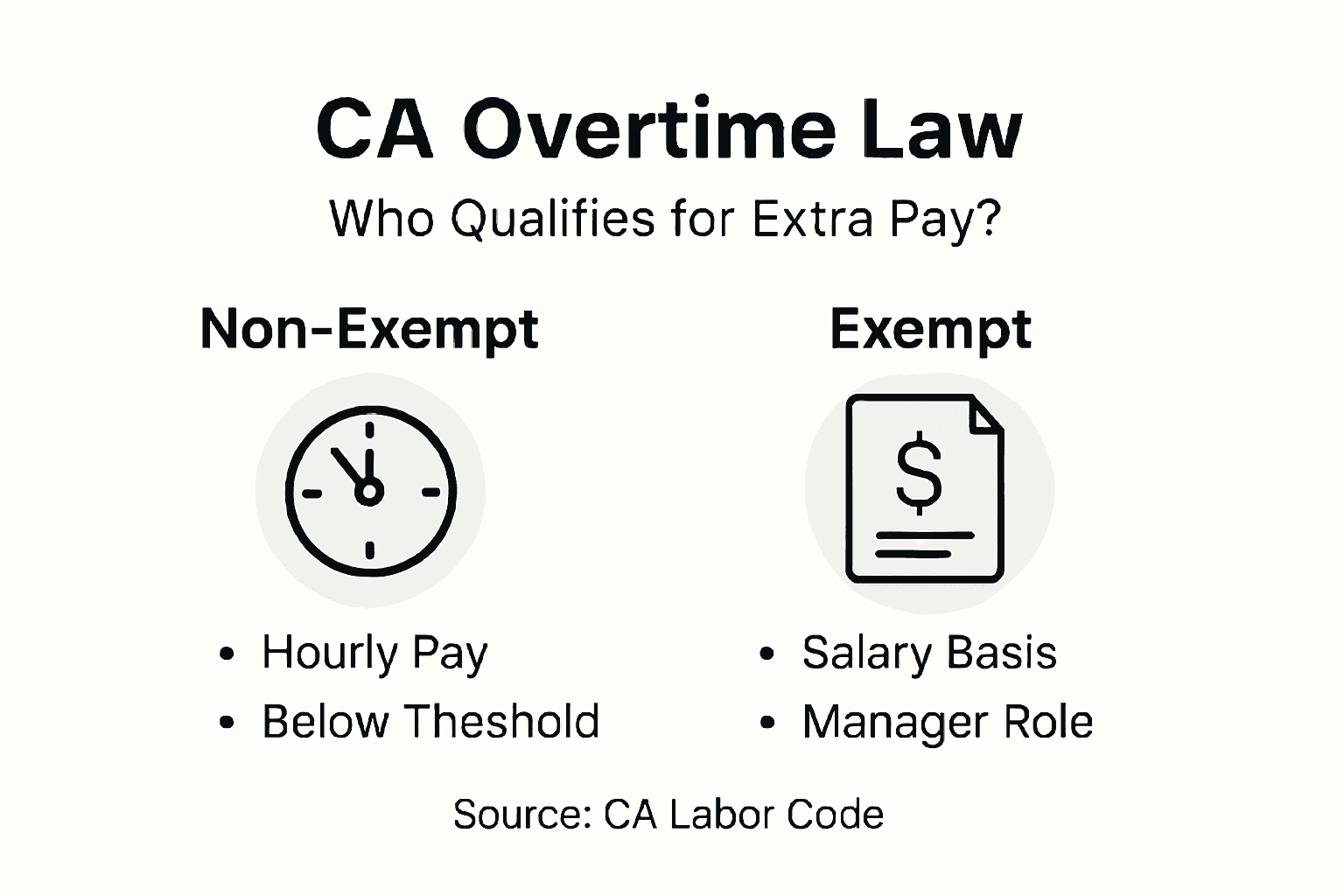
Understanding the critical differences between exempt and non-exempt employees is essential for workers navigating California’s complex labor landscape. Employee classification rules establish fundamental distinctions that significantly impact wage and overtime entitlements.
Key characteristics of exempt employees include:
- Paid a fixed salary rather than hourly wages
- Earn above a specific annual income threshold
- Perform advanced professional, administrative, or executive duties
- Exercise significant independent judgment
- Not eligible for overtime compensation
In contrast, non-exempt employees are characterized by:
Here’s a summary comparing exempt and non-exempt employees in California:
| Criteria | Exempt Employees | Non-Exempt Employees |
|---|---|---|
| Pay Structure | Salaried, fixed amount | Hourly wage based |
| Overtime Eligibility | Not eligible for overtime | Entitled to overtime pay |
| Job Duties | Advanced, specialized responsibilities | Routine or standardized tasks |
| Decision-Making | Significant independence | Limited authority |
| Record-Keeping Required | No mandatory tracking of hours | Must log all work hours |
- Hourly wage compensation
- Earnings below the established salary threshold
- Limited decision-making authority
- Entitled to overtime pay
- Required to track and report hours worked
California labor laws provide more stringent worker protections compared to federal standards, ensuring comprehensive employee classification guidelines.
The determination of exempt status relies on three primary tests:
- Salary Basis Test: Must receive a predetermined, fixed salary
- Salary Level Test: Minimum annual earnings threshold
- Duties Test: Specific job responsibilities and decision-making capabilities
Employers must carefully evaluate multiple factors when classifying workers, including job complexity, autonomy, and compensation structure. Misclassification can result in significant legal and financial consequences.
Pro tip: Review your job description, compensation structure, and actual work responsibilities to verify your correct employment classification.
Calculating Overtime Rates and Payments
Navigating overtime compensation in California requires a nuanced understanding of complex wage calculation methods. Overtime payment regulations establish precise guidelines for determining an employee’s additional compensation beyond standard work hours.
Overtime rates in California are structured as follows:
Below is a quick reference for California overtime pay rates and when they apply:
| Overtime Scenario | Pay Rate (Multiplier) | When It Applies |
|---|---|---|
| Standard daily overtime | 1.5 × regular rate | Over 8 hours in a workday |
| Weekly overtime | 1.5 × regular rate | Over 40 hours in a workweek |
| Seventh consecutive workday (first 8) | 1.5 × regular rate | First 8 hours on day seven in a workweek |
| Daily double time | 2 × regular rate | Over 12 hours in a workday |
| Seventh workday double time | 2 × regular rate | Over 8 hours on seventh consecutive workday |
- Regular Overtime: 1.5 times standard hourly rate
- Hours worked over 8 in a single day
- Hours worked over 40 in a single workweek
- Double Time: 2 times standard hourly rate
- Hours worked over 12 in a single day
- Hours worked over 8 on the seventh consecutive workday
The regular rate of pay includes multiple compensation components:
- Base hourly wage
- Salary
- Commissions
- Piece-rate earnings
- Non-discretionary bonuses
- Performance incentives
California’s overtime calculations provide more comprehensive worker protections compared to federal minimum standards.
Calculating overtime involves several critical steps:
- Determine the employee’s regular hourly rate
- Identify total hours worked beyond standard thresholds
- Multiply excess hours by appropriate overtime multiplier
- Add overtime compensation to standard wages
Employers must maintain meticulous records and accurately track work hours to ensure proper compensation. Alternative workweek schedules can introduce additional complexity, requiring careful interpretation of labor regulations.
Pro tip: Keep detailed personal work logs and pay stubs to verify your overtime calculations and detect potential wage discrepancies.
Employer Liabilities and Common Violations
Employers in California face significant legal risks when failing to comply with overtime regulations. Workplace wage violations can result in substantial financial penalties and potential legal action.
Common overtime violation categories include:
Misclassification of Employees
- Incorrectly labeling workers as exempt
- Denying legitimate overtime compensation
- Avoiding proper wage calculations
Record-Keeping Violations
- Failing to maintain accurate time records
- Manipulating employee work hour documentation
- Inadequate tracking of overtime hours
Compensation Violations
- Underreporting total hours worked
- Miscalculating overtime rates
- Refusing to pay required overtime wages
California labor laws impose strict requirements on employers to ensure workers receive fair compensation for extended work hours.
Legal consequences for overtime violations can be extensive:
- Payment of back wages
- Liquidated damages
- Civil penalties
- Potential criminal prosecution
- Mandatory business corrections
The Labor Commissioner’s Office actively investigates complaints and can impose significant financial sanctions against non-compliant employers. Workers have multiple avenues to report violations, including direct complaints, legal actions, and third-party investigations.
Pro tip: Document every work hour meticulously and retain copies of pay stubs and time records to protect your wage rights.
Take Control of Your Rights Under California Salary Overtime Law
Navigating the complexities of overtime eligibility and correct compensation can feel overwhelming. If you are struggling with understanding whether your job classification is exempt or non-exempt, or if you suspect your employer is miscalculating your overtime pay, you are not alone.
Many California workers face challenges like misclassification, improper wage calculations, and denied overtime wages despite working beyond legal limits.
At California Labor Law, we empower you with clear, trustworthy information about your rights under the state’s salary overtime laws. From detailed legal guides and explanations about exemption criteria to tools that help calculate your owed wages, we provide the resources you need to protect yourself.
Don’t wait to claim the compensation you deserve. Call 1-866-355-9991 now for a free overtime pay consultation to understand your true eligibility for overtime pay and learn how to take action.
Frequently Asked Questions
What are the key overtime pay requirements in California?
In California, employers must pay one and one-half times an employee’s regular rate of pay for working more than 8 hours in a single workday, more than 40 hours in a single workweek, and for the first 8 hours worked on the seventh consecutive day of work.
Who is eligible for overtime pay in California?
To qualify for overtime pay in California, workers must be classified as nonexempt employees, work more than 8 hours in a workday or 40 hours in a workweek, and be 18 years or older, with some exceptions for minors.
What distinguishes exempt employees from non-exempt employees?
Exempt employees are paid a fixed salary and perform advanced professional, administrative, or executive duties, making them ineligible for overtime pay. Non-exempt employees are typically paid hourly, earn less than the salary threshold, and are entitled to overtime pay.
How is overtime pay calculated in California?
Overtime pay in California is calculated by multiplying the employee’s regular hourly rate by 1.5 for standard overtime (over 8 hours in a day or 40 hours in a week) and by 2 for double time (over 12 hours in a day or over 8 hours on the seventh consecutive workday).