




California 1099 vs W2: What Workers Need to Know About Their Rights
Getting paid what you deserve in California can depend entirely on whether you are a 1099 independent contractor or a W2 employee.
For gig workers and freelancers, this difference impacts every paycheck, the taxes you owe, and whether you receive legal protections if your employer underpays you.
Understanding your classification is the first step toward safeguarding your rights under California law, especially when wage theft or misclassification enters the picture.
Defining 1099 Employee and W2 Status
The difference between being classified as a 1099 independent contractor and a W2 employee shapes nearly every aspect of your work life in California. These two classifications determine how you pay taxes, what protections you receive, whether you get benefits, and crucially, what happens if your employer fails to pay you correctly.
Understanding which category applies to you isn’t just about paperwork. It’s about knowing your actual rights under California law.
A 1099 worker is classified as an independent contractor who typically receives income reported on Forms 1099-MISC, 1099-K, or 1099-NEC. These workers maintain control over how and when they complete their work, set their own schedules, and handle their own payroll taxes without employer withholdings.
You’re responsible for paying both the employee and employer portions of Social Security and Medicare taxes, which can add up to roughly 15.3 percent of your earnings.
As an independent contractor, you also bear the cost of your own equipment, workspace, and any training required for the job. The appeal for many gig workers is flexibility, but that freedom comes with significant financial responsibility and fewer legal protections.
Many delivery drivers, rideshare drivers, and freelance service providers fall into this category, though California has specific rules about which gig economy drivers qualify as independent contractors under certain conditions.
In contrast, a W2 employee works under your employer’s control and supervision, with wages reported on Form W-2. Your employer withholds federal and state income taxes, Social Security, and Medicare from your paycheck automatically. This means you don’t need to pay those taxes yourself when you file your return.
W2 employees receive mandatory benefits including workers’ compensation insurance, unemployment insurance eligibility, and access to minimum wage protections under California labor laws. Your employer covers equipment costs, provides a workspace, and typically handles training expenses.
The trade-off is less schedule flexibility, though California law gives you significant protections around rest breaks, meal periods, overtime pay, and other working conditions.
How income is reported federally and on state tax returns directly affects your tax filing and what deductions you can claim.

The fundamental difference comes down to control and relationship structure. When determining if you’re an employee or contractor, California focuses on whether the hiring entity controls how, when, and where work gets done.
If your employer dictates your hours, provides tools and training, supervises your work closely, and integrates you into the company’s operations, you’re likely an employee regardless of what your contract says.
If you truly control your work methods, set your own schedule, work for multiple clients, and maintain an independent business, contractor status may apply. But California courts lean heavily toward employee classification when facts are unclear, which benefits workers significantly.
Here’s a side-by-side comparison of core differences between 1099 independent contractors and W2 employees in California:
| Aspect | 1099 Contractor | W2 Employee |
|---|---|---|
| Tax Withholding | No employer withholding | Taxes withheld automatically |
| Benefit Eligibility | No legal guarantee | Access to statutory benefits |
| Work Flexibility | Sets own hours and methods | Follows employer schedules |
| Legal Protections | Limited, mostly contract-based | Extensive under labor laws |
Pro tip: Request a written classification statement from your employer and verify it matches how you actually work, then contact a California labor advocate if discrepancies exist between your classification and your real working conditions.
Key Legal Tests for Classification in California
California doesn’t rely on what your contract says or what tax forms get filed. The state uses a specific legal test to determine whether you’re actually an employee or independent contractor, and this test overrides almost everything else. This is critical because misclassification can cost employers significant money in penalties, back wages, and damages, which means they have strong incentives to fight your classification claims.
Understanding how California evaluates your status gives you the power to recognize when you’re being wrongly classified and what steps to take.
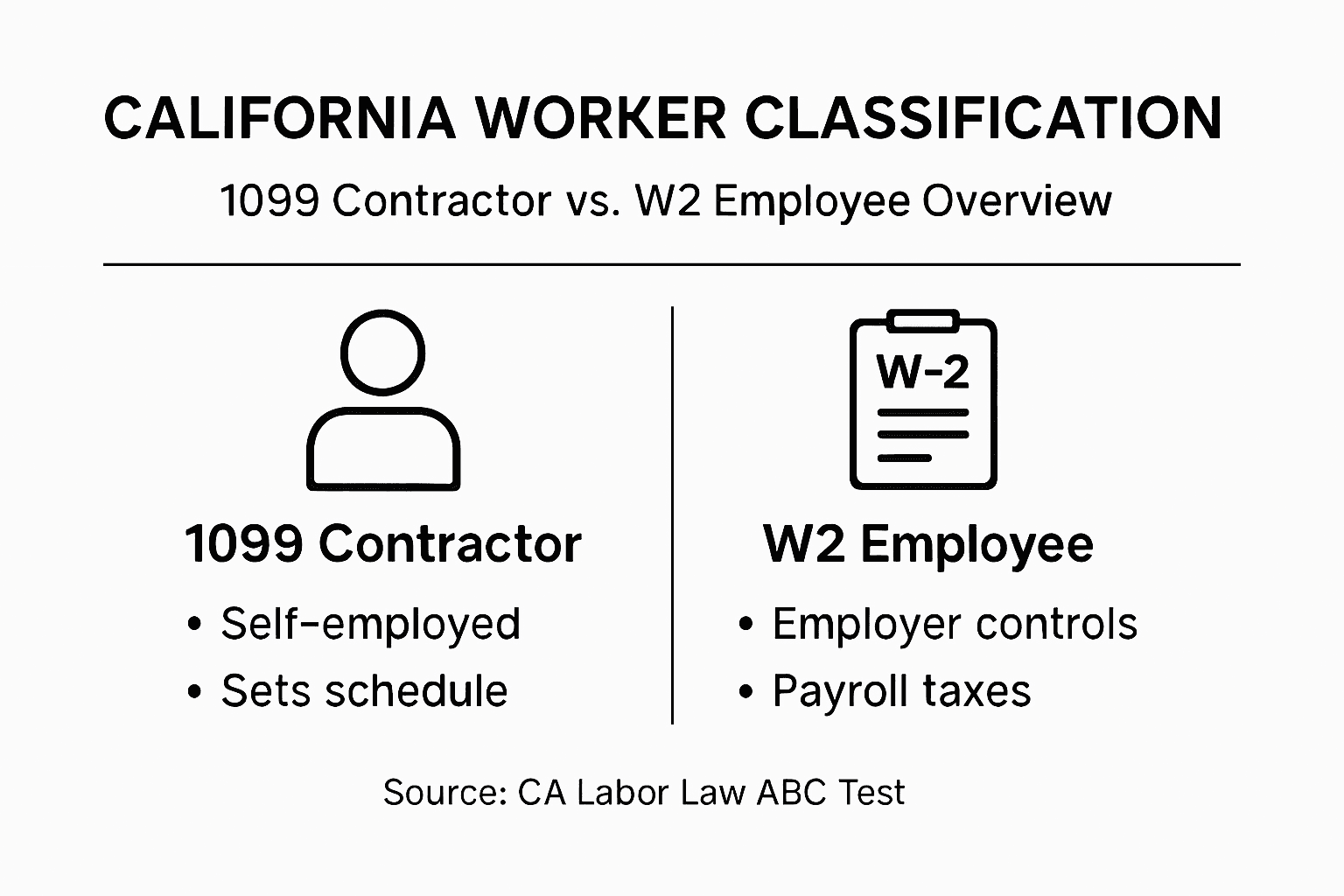
The ABC Test is California’s primary legal standard for classifying workers, and it comes from Assembly Bill 5. Here’s how it works: for you to qualify as an independent contractor, all three conditions must be true simultaneously.
First, the hiring entity must have no control over how you perform your work, including the methods you use and the hours you work.
Second, you must perform work that falls outside the usual business of the company hiring you. Third, you must be independently established in your own trade or business.
Think of it this way: if you’re a freelance accountant working for multiple clients and setting your own hours, you might pass the test. But if you’re working set hours for one company doing exactly what employees do there, you fail the test.
California’s ABC Test framework clarifies that signed agreements and tax forms alone cannot override these requirements, no matter what language your contract contains.
What makes the ABC Test so powerful for workers is that it’s extremely strict. You don’t need to prove you’re misclassified according to some vague standard. California has spelled out exactly what needs to happen, and employers must meet every single criterion.
Many companies try to get around this by having workers sign agreements claiming independent contractor status, but those contracts mean almost nothing if the actual working relationship doesn’t fit the legal test. Courts consistently rule that the reality of how you work matters far more than paperwork.
If you work regular hours, get directions from a manager, use company equipment, and perform core business functions, you’re likely an employee regardless of your contract language or the 1099 forms you receive.
The consequences for misclassification are substantial. Employers who wrongly classify employees face significant legal consequences and misclassification risks including unpaid wages, overtime violations, benefits liability, and civil penalties.
California’s Department of Industrial Relations actively investigates wage theft cases, and misclassification often leads to wage theft claims because misclassified workers typically earn less than they legally deserve. You also lose access to workers’ compensation if injured, unemployment insurance if laid off, and minimum wage protections while working.
These aren’t theoretical risks for many gig workers who discover too late that they should have been classified as employees all along.
Pro tip: Document how you actually work for at least two weeks, noting who controls your schedule, what tools you use, who supervises you, and whether you work for other companies, then compare your real working conditions against the three ABC Test requirements to identify potential misclassification.
Major Distinctions: Pay, Benefits, and Control
The gap between 1099 and W2 status extends far beyond tax forms. Your classification determines whether you receive a steady paycheck, health insurance, workplace protections, or whether you’re left covering every cost yourself.
For gig workers juggling multiple income sources or those misclassified in their current role, understanding these distinctions can reveal thousands of dollars in missing wages and benefits you should have received.
Payroll and tax withholding work completely differently depending on your status. When you’re a W2 employee, your employer deducts federal income tax, Social Security, Medicare, and state income tax directly from each paycheck before you see the money. This means you don’t face a tax surprise when April arrives.
Independent contractors receive the full amount owed with no withholdings, then must set aside money themselves to pay federal and state taxes quarterly, plus both the employee and employer shares of Social Security and Medicare taxes.
The self-employment tax alone adds up to approximately 15.3 percent of your net earnings that you must pay out of pocket. Many 1099 workers underestimate this burden and find themselves short when tax time arrives.
Beyond payroll taxes, W2 employees receive regular wages with payroll taxes withheld and legal protections including minimum wage, while contractors pay their own taxes and receive no minimum wage guarantee if work slows down.
The benefits gap creates significant financial vulnerability for misclassified workers. W2 employees in California have access to workers’ compensation insurance, which covers medical expenses and lost wages if you’re injured on the job. You’re also eligible for unemployment insurance if your employer lays you off or fires you without cause.
Many employers offer health insurance, retirement plans, and paid time off to W2 employees. Contractors get none of this. If you get hurt while working as a 1099 contractor, you’re responsible for your own medical bills and lost income. If work dries up, you receive nothing. If you need a break for illness or personal reasons, you lose income with no safety net.
You also bear the cost of equipment, vehicles, workspace, and any training required for your work. The financial pressure to keep working despite illness or exhaustion is intense for contractors without these protections.
Control over your work schedule and methods represents the final major distinction. W2 employees work under employer direction, with managers assigning tasks, setting schedules, and determining work methods. This means less flexibility but also clear boundaries on expectations. Independent contractors theoretically control when and how they work, choosing their own hours and methods. This sounds appealing until you realize that less control can actually mean more pressure.
When you’re classified as a 1099 contractor, companies often demand faster work, tighter deadlines, and higher quality without adjusting pay. The lack of formal employment relationship means fewer protections against arbitrary demands or payment disputes.
Pro tip: Calculate your actual hourly earnings as a 1099 contractor by subtracting all business expenses and self-employment taxes from gross income, then divide by actual hours worked to see whether you’re earning less than minimum wage, which could indicate misclassification.
Rights, Protections, and Obligations for Each Type
Your employment classification determines not just your paycheck, but whether California law actively protects you from exploitation. W2 employees operate under a comprehensive framework of legal protections built into California’s labor code, while independent contractors largely operate outside this system.
Understanding what protections you should have versus what you’ve actually been given is the first step toward recognizing wage theft or misclassification in your situation.
W2 employees in California enjoy extensive legal protections that contractors simply do not have. You have the right to earn at least minimum wage, currently 16 dollars per hour in most of the state. You’re protected by overtime laws requiring time-and-a-half pay for hours over 8 in a day or 40 in a week. You must receive paid meal and rest breaks.
Your employer cannot retaliate against you for reporting labor violations, demanding unpaid wages, or participating in union activities. You have the right to file wage claims with the California Labor Commissioner if your employer fails to pay you correctly. If injured at work, you’re covered by workers’ compensation insurance without needing to prove fault. If laid off, you can file for unemployment benefits.
These protections exist because California recognizes that employees have less bargaining power than employers and need legal guardrails. Independent contractors receive virtually none of these protections. Employees receive legal protections such as wage and hour laws and protections from retaliation, while independent contractors operate in a largely unregulated space where these laws do not apply.
The flip side of this protection gap is the obligation structure. Independent contractors must handle their own tax obligations, including quarterly estimated tax payments to avoid penalties. You’re responsible for maintaining business records, obtaining any required licenses, carrying liability insurance if necessary, and managing your own retirement savings with no employer contribution.
You cannot claim unemployment benefits during slow periods. You must negotiate your own rates and payment terms, and you have limited recourse if a client refuses to pay beyond small claims court or hiring an attorney.
W2 employees, by contrast, have straightforward obligations: show up for scheduled work, follow company policies, and perform your job duties. Your employer handles tax withholding, insurance, benefits administration, and legal compliance. This sounds simpler until you realize that contractors often work longer hours for less total compensation because they absorb all business costs and risks.
Misclassification creates a dangerous gray zone where workers receive neither the protections of employees nor the genuine independence of contractors. You might be classified as 1099 while working set hours, receiving employer direction, and performing core business functions. This means you lose wage and hour protections, overtime rights, meal break guarantees, and unemployment eligibility without gaining the autonomy or rate-setting power of true contractors.
Misclassification can lead to penalties and worker claims against the employer, but you need to recognize it first and understand your options for challenging it.
Pro tip: Create a detailed list comparing your actual working conditions against California’s employee protections, then contact a labor advocate if you’re classified as 1099 but receive employer direction, set schedules, or lack meaningful independent business operations.
Misclassification Risks and Filing a Wage Claim
Misclassification isn’t a victimless paperwork error. It’s wage theft. When employers knowingly or carelessly classify employees as independent contractors, they avoid paying payroll taxes, providing benefits, and following wage and hour laws. The financial impact on workers accumulates silently until someone does the math and realizes they’ve been underpaid by thousands of dollars.
But here’s what matters for your situation: California law gives you a pathway to recover what you’re owed, and employers face serious consequences for getting this wrong.
The risks employers face for misclassification are substantial enough that they should be incentivizing correct classification, yet many still gamble with workers’ livelihoods.
An employer who misclassifies employees as independent contractors faces back wage claims covering unpaid minimum wage and overtime, plus penalties and interest that can double or triple the original wage theft amount. They become liable for unpaid payroll taxes with penalties from the IRS and California Franchise Tax Board.
Workers’ compensation insurance penalties apply retroactively. If the misclassification was intentional or reckless, California law allows for civil penalties and attorney’s fees, which means you can potentially recover not just your lost wages but also the cost of fighting for them legally.
The Department of Industrial Relations actively investigates misclassification complaints, which can trigger comprehensive audits of a company’s entire workforce. Many employers don’t realize that one worker’s wage claim can unravel their entire contractor classification scheme, exposing similar misclassification across their business.
Filing a wage claim is your formal mechanism for recovering stolen wages, and California makes the process accessible even without an attorney. You file with the California Labor Commissioner’s office, which operates free of charge.
Your claim documents the hours you worked, the wages you should have earned under minimum wage and overtime laws, and the wages actually paid. You need pay stubs if available, text messages or emails showing work instructions, photos of you working, witness statements, and any written communications about your job duties.
The Labor Commissioner investigates your claim and holds a hearing where both you and your employer present evidence. If the Commissioner finds in your favor, your employer must pay you the full amount owed plus penalties. The entire process typically takes several months.
Importantly, protections against retaliation for complaining about misclassification exist under California law, meaning your employer cannot legally fire you, reduce your hours, cut your pay, or otherwise punish you for filing a wage claim. If they retaliate, that becomes a separate illegal act with its own remedies.
Below is a summary of key steps in filing a wage claim for misclassification in California:
| Step | Purpose | Evidence Needed |
|---|---|---|
| Prepare Documentation | Build a strong case | Pay stubs, emails, work logs |
| File with Labor Commissioner | Initiate official claim process | Claim form and supporting docs |
| Attend Hearing | Present case to Commissioner | Witness statements, photos |
| Receive Determination | Get formal decision for wage recovery | Proof of payment or violation |
Timing matters because California has statute of limitations rules. You generally have four years to file a wage claim for unpaid wages, though three years is more common for certain violations. Don’t assume the clock keeps running indefinitely.
Additionally, California’s wage theft laws include penalties and interest that grow over time, so acting sooner typically means recovering more.
Many workers hesitate to file because they fear retaliation or believe the process is too complicated. Both concerns are understandable but shouldn’t stop you. Retaliation is illegal and provable.
The process, while bureaucratic, is designed for workers without legal expertise. Thousands of California workers successfully recover wage theft through the Labor Commissioner each year.
Pro tip: Begin collecting documentation now by photographing your workspace, saving all text messages and emails from your employer, recording your actual hours and work duties, and noting the dates of any conversations about your job responsibilities to build a strong wage claim foundation.
Understand Your Worker Classification and Protect Your Rights Today
If you are trying to navigate the complex distinctions between being classified as a 1099 independent contractor or a W2 employee in California you are facing a crucial challenge that affects your taxes paychecks and legal protections. You may be worried about misclassification losing out on wages overtime benefits or workplace safeguards that every worker deserves.
The strict ABC Test California uses means the reality of your work situation counts more than what your contract states. This can be confusing and scary especially if your employer controls your schedule or tasks yet labels you as a contractor.
At California Labor Law we understand these pains and we provide clear legal guides, helpful calculators, and advocacy support designed specifically for California workers like you.
Call us at 1-866-355-9991 for a free employee misclassification consultation to learn how we can help you recover your owed wages and stand up against unfair labor practices. Your rights under California law matter and immediate steps can make a big difference in protecting your income and future.
Frequently Asked Questions
What is the difference between a 1099 employee and a W2 employee in California?
A 1099 employee (independent contractor) has control over their work schedule, methods, and is responsible for their own taxes, whereas a W2 employee works under employer supervision with taxes withheld automatically and receives benefits and legal protections.
How does the classification of 1099 vs W2 affect tax responsibilities?
1099 contractors must pay their own self-employment taxes and manage their own tax payments, while W2 employees have federal and state taxes withheld from their paychecks automatically, making tax filing simpler for them.
What legal protections do W2 employees have that 1099 contractors do not?
W2 employees are entitled to legal protections like minimum wage, overtime, workers’ compensation, and unemployment insurance; independent contractors typically lack these protections and are responsible for their own business-related expenses.
How can I file a wage claim if I believe I have been misclassified?
To file a wage claim, gather necessary documentation, such as pay stubs and work logs, then file with the California Labor Commissioner’s office. The process includes a hearing to present your case and may result in recovering unpaid wages and penalties.