




The Risks of Employee Misclassification in California: Protecting Your Rights
Most workers in California do not realize that a single error in how they are classified can cost them the right to minimum wage, overtime pay, and vital safety nets.
Misclassification is not just a paperwork issue, it means losing protections many workers depend on every day.
If you are unsure about your employee status, uncovering the truth could mean gaining access to rights and benefits that can directly impact your financial stability and workplace security.
Misclassification of Employees in California Law
Employee misclassification represents a serious legal issue where workers are improperly labeled as independent contractors instead of employees.
In California, this practice is considered a form of wage fraud that systematically strips workers of critical legal protections and benefits.
California law focuses intensely on the actual work performed, not just the contractual language used to define a worker’s status.
Under California statutes, employers cannot simply declare a worker an independent contractor through paperwork. The state applies specific legal tests to determine a worker’s true employment classification, examining factors like control over work performance, integration into business operations, and economic dependency.
Workers misclassified as independent contractors lose essential rights including minimum wage guarantees, overtime compensation, unemployment insurance, workers’ compensation coverage, and collective bargaining protections.
Legal Consequences for misclassification can be severe. Businesses found deliberately misclassifying workers may face significant financial penalties, back wage requirements, and potential civil litigation.
State enforcement agencies like the Bureau of Field Enforcement actively investigate and prosecute such violations, ensuring workers receive appropriate legal protections and compensation.
Pro tip: If you suspect misclassification, document all work details, hours worked, and communication with your employer to build a strong potential legal case.
Employee vs. Independent Contractor: Key Distinctions
In California, the legal classification of workers is far more complex than a simple contract designation. California law applies rigorous criteria to determine worker status, focusing on the actual nature of the working relationship rather than just paperwork labels.
The ABC test provides the primary framework for distinguishing between employees and independent contractors, placing a significant burden of proof on employers to demonstrate that a worker is truly an independent contractor.
Under the ABC test, three critical conditions must be met for a worker to be classified as an independent contractor.
First, the worker must be free from the company’s control and direction in performing work.
Second, the work performed must be outside the usual course of the company’s business.
Third, the worker must be independently established in the same type of work they are performing.
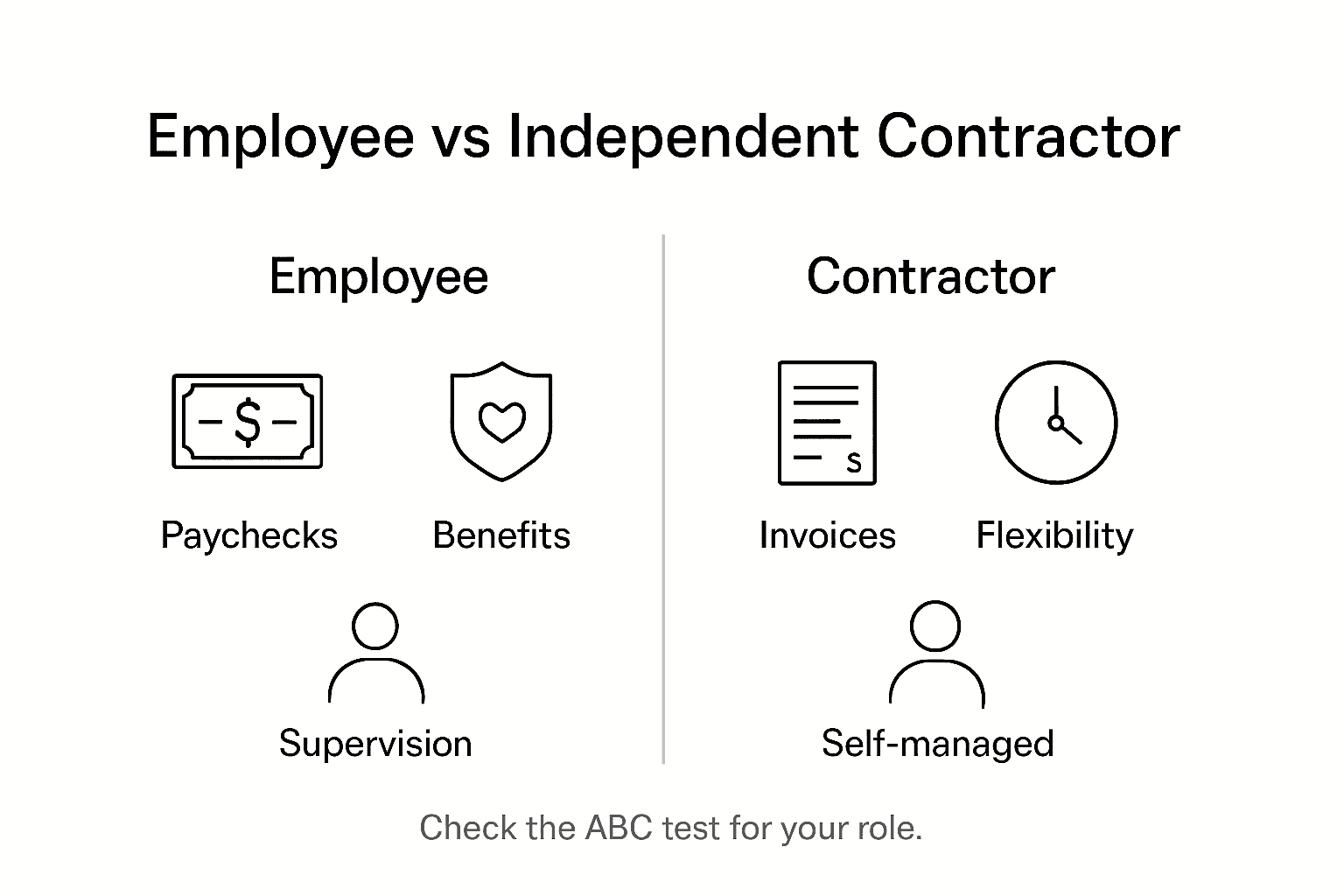
Employees, in contrast, are typically integrated into the company’s core operations, receive regular wages, have taxes withheld, and are subject to direct supervision.
Here’s a side-by-side summary of employee versus independent contractor status in California law:
| Aspect | Employee Status | Independent Contractor Status |
|---|---|---|
| Tax Withholding | Handled by employer | Managed by worker |
| Legal Protections | Extensive; labor laws | Limited; few safeguards |
| Control Over Work | Direct employer control | Worker sets own methods |
| Eligibility for Benefits | Health, unemployment, workers’ comp | Typically not eligible |
The consequences of misclassification can be substantial. Employers face significant legal and financial risks when incorrectly categorizing workers, including potential back wage payments, tax penalties, and civil litigation.
Workers misclassified as independent contractors lose critical protections such as minimum wage guarantees, overtime compensation, unemployment insurance, workers’ compensation, and the right to join unions.
This makes understanding the nuanced distinctions between employee and contractor status crucial for both workers and businesses operating in California.
Pro tip: Request a detailed written description of your work arrangement and compare it against the ABC test criteria to determine your potential employment classification.
Legal Tests for Worker Classification in California
California Assembly Bill 5 (AB 5) transformed worker classification standards by establishing the ABC test as the primary legal mechanism for determining employee status.
This landmark legislation shifted the burden of proof squarely onto employers, creating a presumption that workers are employees unless specific conditions are definitively met.
The test requires employers to demonstrate three critical elements: the worker’s freedom from company control, performance of work outside the company’s core business operations, and active engagement in an independently established professional trade.
The ABC test represents a fundamental shift in how California evaluates employment relationships. Under this framework, employers must satisfy all three prongs of the test to classify a worker as an independent contractor.
The first prong examines the employer’s direct control over work performance, the second evaluates whether the work falls outside the company’s typical business model, and the third requires evidence that the worker operates an independently established business in the same domain.
State labor authorities provide extensive guidance on interpreting and applying these complex legal standards, recognizing the nuanced nature of modern workplace relationships.
While the ABC test provides a comprehensive framework, California law acknowledges that certain professional categories may require alternative classification approaches.
Specific industries and professions can qualify for exemptions, potentially reverting to older multi-factor tests like the Borello test.
These exceptions underscore the complexity of worker classification and highlight the importance of understanding industry-specific legal nuances.
Employers who misclassify workers face significant financial penalties, including potential back wage payments, tax liabilities, and legal sanctions.
Pro tip: Consult with an employment law specialist to thoroughly review your specific work arrangement and verify proper classification under California’s intricate legal standards.
Rights and Protections Lost Through Misclassification
Workers misclassified as independent contractors forfeit numerous critical legal protections that employees automatically receive under California labor laws.
Workplace rights can be dramatically compromised by improper classification, creating substantial financial and professional vulnerabilities for workers who lack fundamental employment safeguards. These lost protections extend across multiple dimensions of workplace safety, compensation, and legal recourse.
The most significant rights eliminated through misclassification include essential wage and hour protections. Independent contractors lose guaranteed minimum wage standards, overtime compensation, meal and rest break requirements, and protection against wage theft.
They become ineligible for critical benefits such as health insurance, workers’ compensation, unemployment insurance, and disability coverage.
Additionally, misclassified workers surrender important legal protections like protection from workplace discrimination, sexual harassment safeguards, and the right to collectively bargain or join unions.
Beyond immediate financial implications, misclassification creates long-term professional risks. Workers classified as independent contractors bear full responsibility for tax withholdings, lack structured career advancement opportunities, and have minimal legal recourse in disputes with hiring entities.
The financial burden of self-employment taxes, absence of employer-sponsored retirement plans, and increased personal liability can create significant economic instability.
These systemic disadvantages disproportionately impact workers in vulnerable industries, transforming what appears to be flexible work into a precarious employment arrangement.
The table below highlights which workplace rights are lost when a worker is misclassified in California:
| Lost Protection | Impact on Worker | Long-term Consequence |
|---|---|---|
| Overtime Pay | No extra compensation | Lower annual income |
| Unemployment Insurance | Ineligible for support | Financial instability after job loss |
| Collective Bargaining | Cannot join a union | Weakened negotiating power |
| Employer-sponsored Retirement | No retirement plan access | Higher retirement planning burden |
Pro tip: Document all work-related communications, hours worked, and job responsibilities to build evidence supporting your potential employee classification.
Employer Liability and How Workers Can Take Action
California’s labor regulations establish comprehensive employer liability for worker misclassification, creating multiple avenues for workers to seek justice and compensation. The state’s legal framework provides robust protections that enable employees to challenge improper classification without fear of retaliation.
Workers retain critical rights to pursue claims regardless of their immigration status, ensuring a level playing field for all workers subjected to potential workplace violations.
Employers face significant legal and financial consequences for misclassification. Potential penalties include substantial fines, mandatory back wage payments, and potential civil litigation.
Workers can initiate action through several official channels, including filing complaints with the California Bureau of Field Enforcement, the Labor Commissioner’s Office, or through direct legal action.
The state offers multilingual support and explicit protections against employer retaliation, empowering workers to assert their rights without risking their professional standing or future employment opportunities.
The process of challenging misclassification involves gathering comprehensive documentation of work performance, hours, responsibilities, and communication with the employer.
Workers should collect critical evidence such as:
- work contracts,
- communication records,
- payment documentation,
- and detailed accounts of job duties.
An employment attorney can provide strategic guidance in navigating the complex legal landscape, helping workers understand their specific rights and the most effective approach to addressing potential misclassification.
Collective actions may also be available for groups of workers experiencing systematic misclassification, multiplying the potential impact of legal challenges.
Pro tip: Maintain a detailed, contemporaneous record of all work-related activities and communications to strengthen your potential legal claim.
Protect Your Rights Against Employee Misclassification in California
If you feel your work arrangement might not meet the strict legal standards under the ABC test or if you suspect wage theft due to improper classification, it is critical to understand your rights and act quickly.
At California Labor Law, we provide trusted resources and clear guidance to help you identify if you have been misclassified. Our site offers detailed legal information, wage calculators, and direct access to advocates ready to assist you.
Don’t let misclassification cost you what you deserve. Take the first step toward recovering unpaid wages and protecting your future by calling 1-866-355-9991 for a free California employee misclassification consultation.
Frequently Asked Questions
What is employee misclassification?
Employee misclassification occurs when a worker is incorrectly labeled as an independent contractor rather than as an employee, stripping them of essential legal protections and benefits.
What are the risks of being misclassified as an independent contractor?
Workers misclassified as independent contractors lose key rights, such as minimum wage guarantees, overtime pay, unemployment insurance, workers’ compensation, and the ability to collectively bargain.
How can I determine if I am misclassified as an independent contractor?
To determine if you are misclassified, compare your work arrangement against the ABC test criteria, which assess your control over work, the nature of the work in relation to the business, and whether you operate an independently established trade.
What should I do if I suspect I am misclassified?
If you suspect misclassification, document your work details, hours, and communications with your employer. Consult with an employment law specialist for guidance on addressing your classification status.