



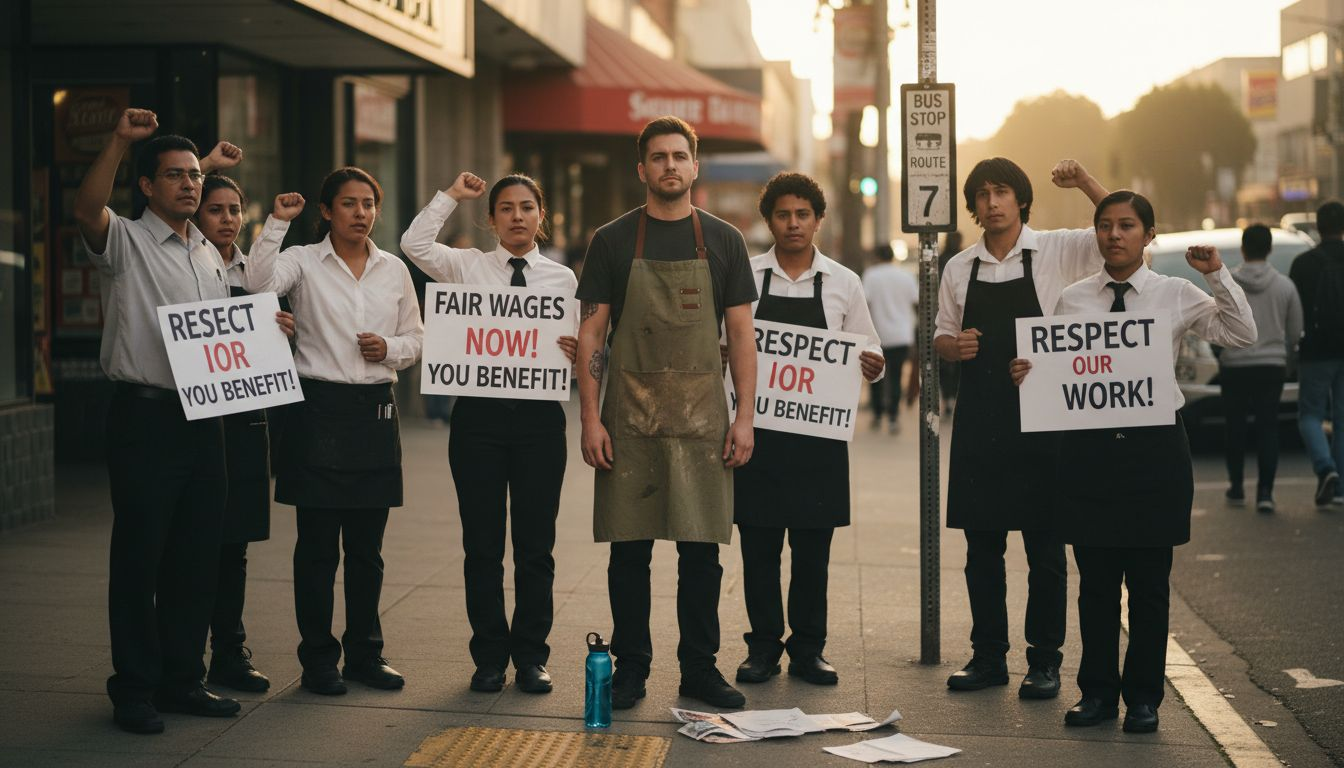
Can You Get Fired for Protesting in California? 2026 Legal Guide
Standing up to unfair working conditions often feels risky for California service workers who rely on every paycheck. Many worry that joining a protest or speaking out could cost them their jobs, especially with confusing advice about at-will employment and employer retaliation.
Understanding the real boundaries of employee protesting rights in California can mean the difference between protecting your job and unintentionally crossing a line, so you know how the law shields your voice—and when it does not.
Employee Protesting Defined and Misconceptions
When you think about protesting at work, your mind might jump to dramatic scenes of picketing or organizing walkouts on company property. But the reality is much more nuanced, especially in California where labor protections are among the strongest in the nation.
Employee protesting refers to any form of collective or individual action taken by workers to express grievances about working conditions, wages, scheduling, or other workplace issues. This can range from formal union activities and coordinated strikes to quieter forms of resistance like refusing to work overtime or wearing protest pins. The key distinction is that the activity must stem from workplace concerns and involve some element of collective action or solidarity with coworkers, even if you’re acting alone.
Here’s where many people get confused. California law provides robust protections for employees engaging in protected political activity, but these protections have specific boundaries that often surprise workers. You are protected when you protest during your nonworking hours and away from your employer’s premises.
If you organize a march about labor conditions on your own time after your shift ends, you cannot be fired for that. You’re protected if you attend city council meetings to speak about wage theft in your industry. You’re protected if you post about workplace issues on your personal social media account outside of work hours. However, this protection has limits.
Your employer can discipline you if you protest on company time without permission, disrupt work operations, or engage in conduct that interferes with your job performance or the business itself. The distinction comes down to timing and location: your rights are strongest when you’re off the clock and off the premises.
Common misconceptions abound because people often confuse what should be protected with what actually is protected. One major myth is that any protest at work automatically gets you fired, period. Not true.
Another misconception is that your employer must allow you to protest on company time or property as long as it’s about work issues. Also not true. Some workers believe that posting criticism of your employer on Facebook automatically violates company policy and can get you terminated. Depending on what you post and how, this might actually be protected speech.
Others assume that joining a union or participating in union activities puts them at risk, but federal and California law protect these specific activities extensively. The reality is more textured. Your protections depend on whether you’re engaged in concerted activity (working with others) versus individual complaints, whether you’re protected by union membership, whether your speech addresses matters of public concern versus purely private employment disputes, and the specific timing and location of your actions.
Understanding these nuances is critical because miscalculating your protection level could cost you your job.
Service industry workers face unique challenges here. You might work irregular shifts, have little job security, and feel tremendous pressure to stay silent about conditions. Many hospitality and food service workers assume they have no protection because they’re at-will employees. This is partially true, but it’s incomplete.
Your at-will status means your employer can fire you for almost any reason, but not for illegal reasons. Protesting working conditions in protected ways is not an illegal reason. The challenge is that your employer might frame termination differently or make your life uncomfortable before firing you, which is why understanding exactly where the legal line sits matters so much.
Here’s a summary of common misconceptions versus realities of workplace protest rights in California:
| Misconception | Actual Legal Protection | Risk Level |
|---|---|---|
| Any protest at work leads to firing | Some protests are protected by law | Medium |
| Employer must allow on-site protests | On-site protests may be restricted | High |
| Social media criticism always risks termination | Protected if posted off duty about public concern | Low to Medium |
| Union participation puts job at risk | Union activities have strong protections | Low |
Pro tip: Document the dates, times, and nature of any workplace protest or protected activity you engage in, along with any negative employment action that follows, so you have clear evidence if retaliation occurs.
California Labor Laws Protecting Protest Rights
California’s legal framework for protecting employee protest rights is among the most comprehensive in the United States. The state recognizes that workers have fundamental rights to organize, speak out about workplace conditions, and take collective action without fear of retaliation.
These protections stem from multiple sources of law working together:
- the California Labor Code,
- the California Constitution,
- federal labor statutes,
- and decades of court decisions that have consistently sided with workers when employers attempt to silence legitimate protest activities.
Unlike many states where labor protections are minimal, California has actively strengthened worker rights through legislation and judicial interpretation, which means you likely have stronger protections than you might realize.
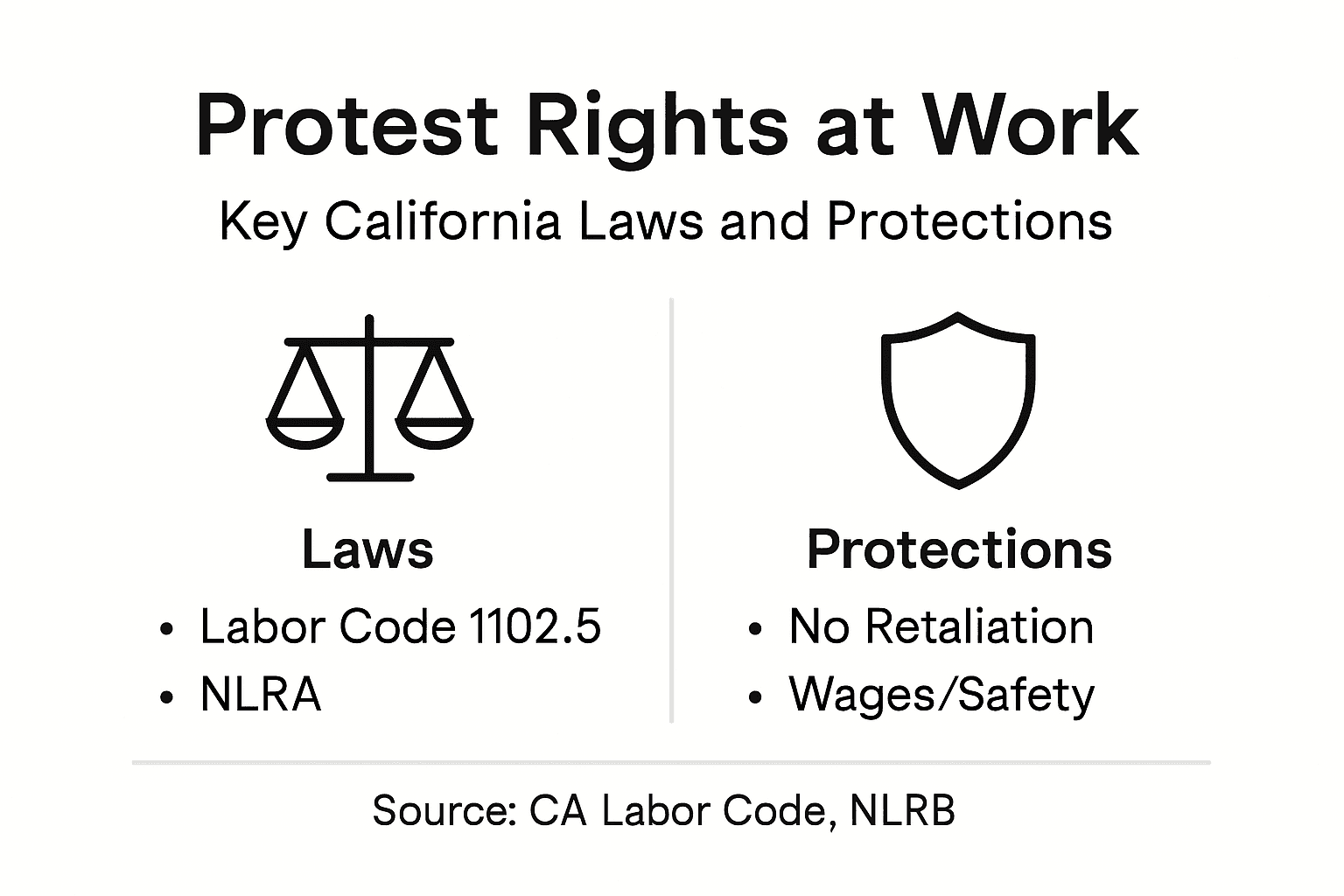
One of the most critical protections comes from California Labor Code Section 1102.5, which shields employees who report unsafe working conditions, wage violations, or other labor law breaches. This statute prevents your employer from retaliating against you for complaining about violations of state or federal law.
Another key protection is found in Labor Code Section 1103, which specifically protects employees who are members of labor organizations or engage in lawful union activities.
California courts have also recognized that employees have broad First Amendment rights when speaking about matters of public concern, even if those comments involve their employer. This means if you post on social media about wage theft in your industry or conditions that affect public health and safety, you have stronger protection than if you were simply complaining about your individual paycheck.
The state also recognizes concerted activity, which refers to when two or more employees act together to improve workplace conditions. You can refuse unsafe work, discuss wages with coworkers, organize meetings about scheduling issues, or participate in strike activities. Your employer cannot fire you, threaten you, or punish you for these collective actions.
When it comes to specific protected activities, California law covers far more ground than many workers understand. You cannot be fired for participating in union organizing, attending union meetings, or voting in union elections. You’re protected when you refuse to cross a picket line in solidarity with striking workers.
You have the right to discuss your wages and working conditions with coworkers without fear of retaliation, a protection that applies even if your employer has policies forbidding such discussions. You’re protected when you report health and safety violations to government agencies like Cal/OSHA.
You cannot face retaliation for taking time off to vote, serve on jury duty, or attend court proceedings related to your employment. If you engage in workplace harassment investigations, your employer cannot punish you for participating in that process. You’re also protected for participating in paid family leave, requesting reasonable accommodations under the Americans with Disabilities Act, or complaining about discrimination based on protected characteristics. The list goes on. What ties all these together is that California has decided the public interest in protecting worker rights outweighs the employer’s interest in complete control over their workforce.
The specific protections vary slightly depending on what type of protest activity you’re engaged in. Union activities receive explicit statutory protection under both California and federal law. Wage and hour complaints are shielded under multiple statutes. Health and safety complaints have strong protections through whistleblower laws.
Political speech and advocacy receive constitutional protection, though this is more nuanced depending on whether you’re speaking on matters of public concern. Discrimination complaints are protected under state and federal civil rights laws.
What’s crucial to understand is that your protection is strongest when your protest or complaint involves violations of law, when you’re part of a group of workers taking action together, and when your activity doesn’t occur during paid work time without permission.
Your protection is weakest if you’re making purely private complaints that don’t involve legal violations, acting entirely alone without any concerted activity, or disrupting work operations in ways that genuinely interfere with business functions. The law balances worker rights with employer interests, but California’s balance tips heavily toward protecting workers.
Pro tip: If you plan to engage in protest or report violations, put your complaint in writing through email or documented communication so you have evidence of exactly what you reported and when, making any subsequent retaliation easier to prove.
At-Will Employment and Wrongful Termination Risks
You’ve probably heard the term “at-will employment” thrown around, and if you work in California, you might think it means your employer can fire you for absolutely any reason whenever they want. That’s partially true, but only partially.
At-will employment means your employer can terminate you without cause and without advance notice. You can be fired on a Monday morning with no warning, no performance issues documented, and no stated reason. California is an at-will employment state, which gives employers significant power over their workforce.
But here’s the critical part that changes everything: at-will employment has exceptions.
Your employer cannot fire you for illegal reasons, and protesting working conditions in protected ways is not an illegal reason to terminate someone. Understanding where the line sits between permissible termination and wrongful termination can be the difference between losing your job unfairly and having legal recourse.
Wrongful termination occurs when your employer fires you in violation of a statute, public policy, or an implied contract. In the context of protesting, wrongful termination claims may succeed if you can demonstrate that your termination was retaliation for protected activity.
The research is clear on this point: at-will employment allows employers to fire employees for any reason or no reason unless protected by law, and employers may take adverse actions if protest activity interferes with job duties or workplace harmony. This distinction matters enormously. If you protest on your own time about conditions that affect public safety, and your employer fires you the next day, that’s likely wrongful termination.
If you refuse to work during a shift without permission to organize a walkout and disrupt customer service, and you get fired, that’s probably permissible termination. The employer’s ability to maintain operations and prevent disruption still carries legal weight, even when you’re engaging in protected activity.
What makes a wrongful termination claim stick in the context of protest activity comes down to proving specific elements. You need to show that you engaged in protected activity, meaning your protest or complaint involved matters protected by law like:
- health violations,
- wage theft,
- union organizing,
- or speaking about public safety concerns.
You need to demonstrate that your employer knew about your protected activity.
You need to establish that you suffered an adverse employment action, which could be termination, demotion, reduced hours, or other negative consequences. Most importantly, you need to prove causation: that your protected activity was the reason, or a substantial motivating factor, for the negative action. Your employer doesn’t have to admit this.
They might claim they fired you for poor performance or attendance issues. But if the timing is suspicious (fired shortly after reporting a violation), if similarly situated employees weren’t punished for the same conduct, or if the stated reason doesn’t match reality, you can build a case. The burden is on you to prove retaliation, but California courts and the Labor Commissioner take these cases seriously, particularly when service industry workers are involved.
The specific risks you face depend on how obvious the retaliation looks. If your employer fires you the day after you file an OSHA complaint, that’s an obvious risk that courts view skeptically. If they fire you three months later with a documented pattern of performance issues, that’s a trickier case. If they reduce your hours after you organize coworkers to discuss wages, that’s retaliation. If they schedule you for unpopular shifts after you complained about safety conditions, that’s potentially retaliation.
The challenge is that employers have learned to cover their tracks. They’ll document performance issues after you protest, claiming the termination was for those reasons. They’ll claim the protest disrupted operations so severely that business necessity required termination. They’ll restructure your position or claim your job was eliminated. Your job as a worker is to recognize that these post-hoc justifications can be challenged if the real reason was your protected activity.
Proving wrongful termination is possible, but it requires evidence, documentation, and often legal representation to navigate the complexities.
Pro tip: If you believe you’ve been fired or punished for protesting, do not sign any severance agreements without consulting an employment attorney, as signing away your rights can eliminate your ability to pursue a wrongful termination claim.
Federal and State Laws on Legal Protesting
Your right to protest as an employee doesn’t exist in a vacuum. It’s backed by a layered system of federal and state laws that work together to shield you from employer retaliation. At the federal level, the National Labor Relations Act (NLRA) is your foundation. Passed in 1935, the NLRA protects workers’ rights to organize, bargain collectively, and engage in protected concerted activities. This means you can talk with coworkers about wages, refuse to work unsafe conditions, participate in strikes, and organize without your employer punishing you.
The NLRA applies to most private sector employees, though it excludes some categories like agricultural workers, domestic workers, and independent contractors. California layers additional protections on top of federal law, creating a stronger shield for workers in the state. Where federal law sets a floor, California often raises that floor higher, giving you more comprehensive protections than workers in most other states.
California’s specific labor codes create additional safeguards beyond what the NLRA provides. Labor Code Section 1102.5 protects employees who report violations of law to government agencies or internally, preventing retaliation for whistleblowing. Labor Code Section 1103 explicitly protects membership in labor organizations and lawful union activities. The state also recognizes broader First Amendment protections than some states, meaning your speech about matters of public concern receives constitutional protection even when it involves your employer.
California courts have consistently held that unfair labor practices and discrimination for engaging in protected concerted activities are prohibited. These frameworks ensure employees’ rights to organize and advocate without fear of employer reprisals.
Additionally, California prohibits retaliation for taking protected time off like jury duty, voting, or attending court proceedings. The state even protects employees who refuse to work in conditions that violate health and safety standards, a protection that goes beyond many other jurisdictions.
What’s crucial to understand is that these laws create multiple overlapping protections. If your employer retaliates against you, you might have claims under federal law, state labor codes, constitutional protections, and common law wrongful termination simultaneously.
The distinction between federal and state protections matters when you’re determining your options after retaliation. Federal claims go through the National Labor Relations Board (NLRB), which investigates unfair labor practices and can order remedies like reinstatement and back pay. Federal law is particularly strong on union organizing and concerted activity.
State claims go through California’s Labor Commissioner or civil court, where you can pursue wrongful termination lawsuits and recover damages including:
- lost wages,
- emotional distress,
- punitive damages in cases of malice,
- and attorney fees.
California law is particularly strong on whistleblower protection and individual complaints about violations. Many situations involve both federal and state claims running parallel. If you’re fired for union organizing, that’s both a federal NLRA violation and a potential state wrongful termination claim. If you’re fired for reporting wage theft, that’s a state whistleblower claim that federal law might also protect. The beauty of this layered system is that if one claim stumbles, others can still succeed. Your employer can’t avoid liability by structuring their violation in a certain way because multiple legal avenues cover similar conduct.
Understanding which laws protect your specific situation is critical. If your protest involves union organizing or collective bargaining, federal law under the NLRA is your strongest tool. If your protest involves reporting violations to government agencies, California whistleblower laws are your strongest tool. If your protest involves political speech about public safety or matters of broad public concern, constitutional protections become central.
If your protest involves refusing unsafe work, occupational safety laws protect you. Service industry workers in California enjoy particularly strong protections because the state has enacted numerous wage and hour laws, break period requirements, and working conditions standards that workers can complain about without retaliation. Many hospitality and food service workers assume they have no rights because they’re at-will employees, but this overlooks the substantial statutory protections California provides.
The key is matching your situation to the right law. If you protest about conditions that violate a statute, you have protection. If you protest about purely personal grievances with no connection to legal violations, your protection is weaker unless you’re engaging in concerted activity with other workers.
Pro tip: Document which specific law or statute your protest relates to (like health violations, wage theft, or union organizing) because the stronger your claim aligns with clear statutory language, the easier it is to prove retaliation and hold your employer accountable.
Use this table to compare major California and federal laws protecting employee protests:
| Law or Statute | Area Protected | Who Enforces | Typical Coverage |
|---|---|---|---|
| NLRA | Union organizing, concerted activity | NLRB | Most private sector employees |
| CA Labor Code 1102.5 | Whistleblowing, reporting legal violations | State Labor Commissioner | All employees in California |
| CA Labor Code 1103 | Union membership, lawful union acts | State Labor Commissioner | Union and non-union workers |
| First Amendment (CA) | Public concern speech | State or federal courts | Broadest for matters of public interest |
Practical Steps and Mistakes to Avoid
Before you organize, speak out, or take any form of protest action at work, you need a strategy. Winging it might feel empowering in the moment, but it can cost you your job and undermine your cause. The difference between protected protest and unprotected conduct often comes down to the specific choices you make about timing, location, and method. Start by understanding your company’s actual policies. Most employers have written protest or political activity policies buried somewhere in your employee handbook or posted on workplace bulletin boards. Read them carefully.
Your employer can enforce reasonable policies about protest activities, and knowing what they prohibit helps you stay on the right side of the line. Next, assess whether your protest involves a legal violation. If you’re complaining about unpaid wages, unsafe conditions, discrimination, or union organizing, you have statutory protection. If you’re protesting purely personal workplace disagreements with no connection to legal violations, your protection is much weaker. This doesn’t mean you shouldn’t act, but it means you should recognize the risk level and plan accordingly.
The practical steps you should take before protesting depend on your specific situation. If you’re organized with other workers, communicate clearly about your goals and methods before taking action. When multiple employees act together deliberately, you have concerted activity protection. When you act alone without coordination, your protection is limited unless you’re reporting violations. Document what you plan to protest and why. Write it down, send yourself an email, create a dated record. This documentation proves you engaged in protected activity if your employer later claims you were fired for different reasons.
Know the timing and location of your protest. You are protected when you protest on your own time and away from company premises. After your shift ends and on public property or your own home, you have maximum protection. During work hours or on company property without permission, your protection shrinks considerably.
If your protest will involve media, social media posts, or communication outside the company, plan that carefully. You cannot be fired for posting about work conditions on your personal social media account on your own time, but screenshots and spread among coworkers can complicate the situation. The safest approach is to stick to facts and avoid false statements that could be characterized as defamation.
Common mistakes destroy otherwise protected activity. Protesting on company time without permission is the biggest error. You walk a picket line during your shift, and your employer fires you. That termination might be permissible because you disrupted work operations. Wearing your company uniform while protesting sends a confusing message and can be prohibited. Your employer can require that you change clothes before engaging in protest because you’re no longer representing the company officially.
Using company resources for protest activities is another mistake. Do not use the company email system, messaging platforms, computers, or printing facilities to organize or promote protest. Do not hold protest meetings in the company break room during work hours without permission.
Do not solicit coworkers to participate in protest activities during work time without permission. These actions can give your employer legitimate grounds for discipline separate from the protest itself. Avoid language that could be characterized as threatening, harassing, or insubordinate. Protesting is not an excuse to ignore your boss, use hostile language, or create a hostile environment. Keep your conduct professional even when your message is confrontational.
The final step is documenting everything if retaliation occurs. Keep records of the protest activity itself: dates, who participated, what was said, what demands were made. Keep records of any negative employment action that follows: termination, demotion, scheduling changes, reduced hours, negative performance reviews. Write down the timeline. How soon after the protest did the negative action occur? Days? Weeks? The quicker the retaliation follows the protest, the stronger your case. Save all written communications with your employer. If your boss mentions the protest in an email, text, or conversation, that’s valuable evidence. If your employer suddenly documents performance issues after years of positive reviews, that’s suspicious.
Take screenshots of social media posts, company policies, and any communications related to the protest. If you believe retaliation has occurred, consult an employment attorney before taking any further action. Do not sign severance agreements, do not resign, and do not accept the termination as final. Many workers make the mistake of accepting termination quietly because they fear it will only make things worse. Actually, consulting an attorney quickly preserves your legal options and often results in better settlements than accepting termination silently.
Pro tip: Before protesting, send yourself an email documenting exactly what you plan to protest, why you believe it violates law, and when you will protest, so you have timestamped proof of your planning that predates any employer retaliation.
Protect Your Rights When Protesting at Work in California
If you fear losing your job for speaking out or taking action about unfair workplace conditions you are not alone. The challenge of understanding your protections under at-will employment and California’s complex labor laws can feel overwhelming.
Take control of your situation by visiting California Labor Law where you will find comprehensive guides, legal updates, and tools to help you clearly document any retaliation and understand your options.
Do not wait until it is too late. Learn more about how California law protects your voice and get the help you deserve now at California Labor Law. Call 1-866-355-9991 for a free protesting rights consultation today.
Frequently Asked Questions
Can my employer fire me for protesting during my shift?
Protesting during your shift without permission can lead to termination, as it may disrupt work operations. It’s crucial to only protest during nonworking hours to maintain legal protections.
What protections do I have if I protest about working conditions?
In California, you are protected when you protest about workplace conditions, wages, or safety issues as long as you do so on your own time and away from the company’s premises. Engaging in concerted activity with coworkers also enhances your protections.
Can I be fired for posting about workplace issues on social media?
You cannot be fired for posting about workplace issues on your personal social media account during your own time, especially if your comments relate to public concerns. However, be cautious about defamation or false statements.
What should I do if I believe I’ve been retaliated against for protesting?
If you suspect retaliation for your protest, document all relevant activities, any communications from your employer, and the timeline of events. Consulting with an employment attorney can help protect your rights and navigate potential wrongful termination claims.