




How Is Trump’s Immigration Enforcement Affecting Latino Workers in California?
California could lose up to $278 billion in GDP if mass deportation policies are fully implemented, according to a June 2025 study by the Bay Area Economic Institute and UC Merced. ICE deported at least 8,250 people from California during just the first nine months of 2025, with removals surging sharply over the summer (Sacramento Bee, January 2026).
The state is home to 10.6 million immigrants, of whom 2.28 million are undocumented. These workers represent 8% of California’s entire labor force and generate nearly 5% of the state’s gross domestic product through direct wages alone — a figure that rises to 9% when accounting for economic ripple effects (Bay Area Economic Institute, 2025).
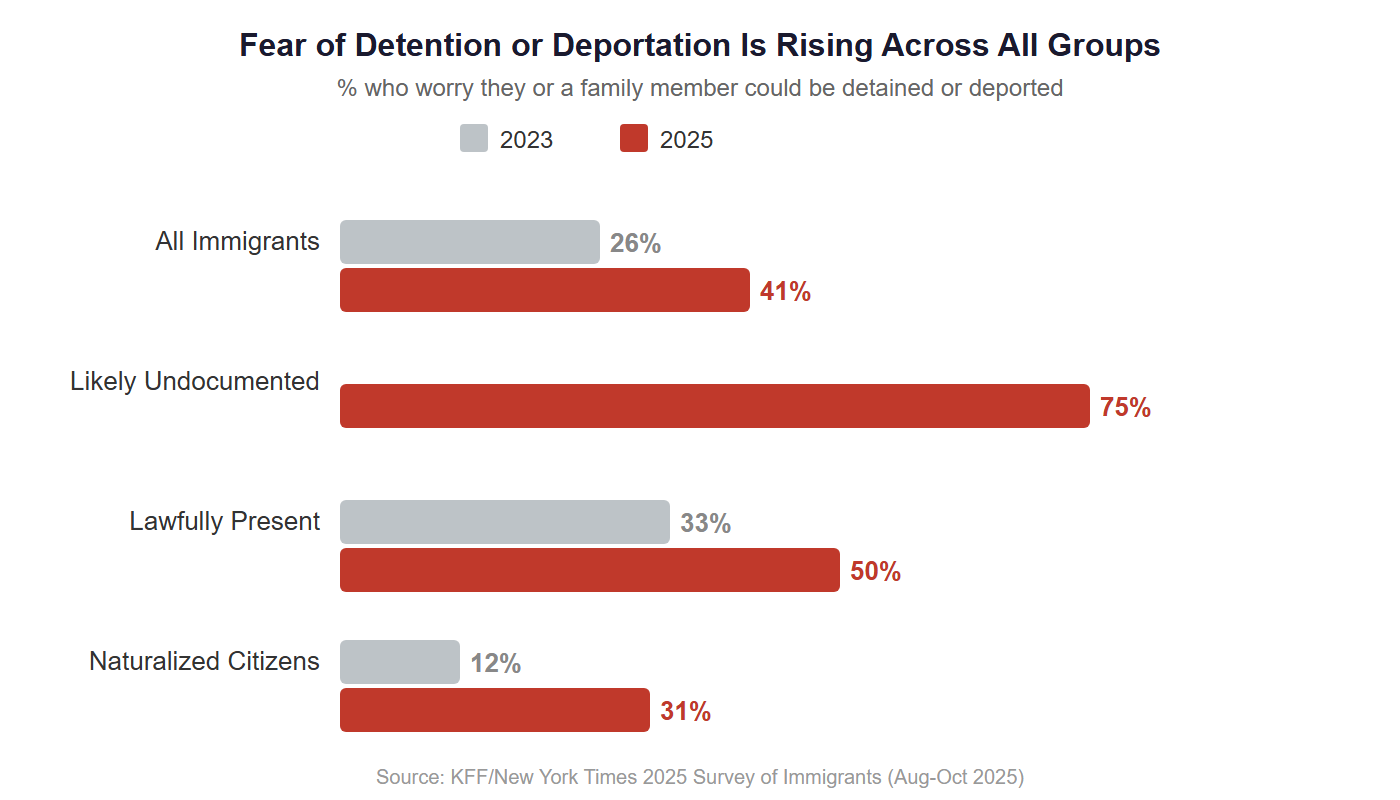
The KFF/New York Times 2025 Survey of Immigrants found that 41% of all immigrants now worry about detention or deportation — up from 26% in 2023. Among undocumented immigrants, that figure reaches 75%. This fear is reshaping entire industries across the state.
How Much Do Latino and Immigrant Workers Contribute to California’s Economy?
California’s Latino population generated more than $1 trillion in economic output in 2023, according to a UCLA and Cal Lutheran report published in July 2025. Without that contribution, California would have dropped from the fifth-largest to the eighth-largest economy in the world.
The numbers reveal the depth of this economic engine. The Latino labor force in California is growing at a rate 15 times faster than the non-Latino labor force, and 41% of working-age Latinos in the state were immigrants in 2023. Latino immigrants alone may be responsible for as much as $400 billion in annual economic output (UCLA, 2025).
Immigrants as a whole are equally vital. One in three California workers — 6.1 million people — is an immigrant (California Budget & Policy Center, 2025). Nearly 900,000 immigrants in the state are entrepreneurs, collectively generating $28.4 billion in business income. Undocumented immigrants alone contribute $8.5 billion annually in state and local taxes.
These are not abstract numbers. They represent the farmworkers who harvest California’s $49 billion agriculture industry (CNBC, 2025), the construction crews rebuilding homes after the Palisades wildfires, and the caregivers supporting the state’s aging population.
Which California Industries Are Most at Risk From Immigration Enforcement?
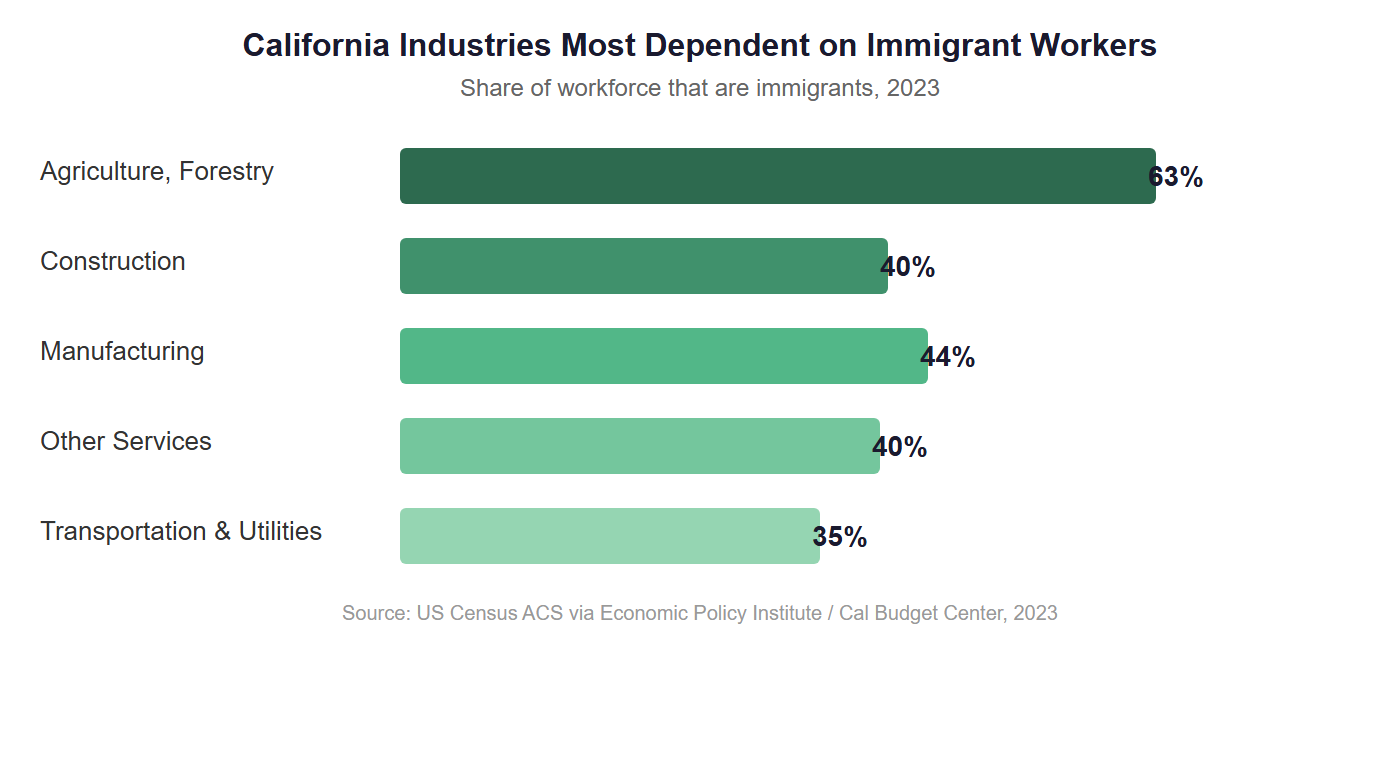
Agriculture and construction face the most severe disruptions, with potential GDP contractions of 14% and 16% respectively if undocumented workers are removed from those industries (Bay Area Economic Institute, 2025). These sectors depend heavily on immigrant labor, and no domestic workforce is available to fill the gap.
Agriculture and Food Production
California leads the nation in agricultural production, accounting for nearly 12% of all US commodities. Over one-third of the country’s vegetables and more than three-quarters of its nuts and fruits are grown in the state (CDFA). The workforce behind this output is 63% immigrant and 24% undocumented (Bay Area Economic Institute, 2025).
“Without them, we wouldn’t have any food available,” Joe Garcia, president of the California Farmworker Association, told CNBC in September 2025. He noted that automation is not viable for many harvesting jobs, and American-born workers are largely unwilling to take on the strenuous, low-paid outdoor work.
Farmworkers have reported being too scared to show up to work, leaving crops unharvested and threatening not just farm revenue but the food banks and supply chains that depend on California-grown produce.

Photo by Circe Denyer / Pexels
Construction and Housing
California’s construction industry relies on a workforce that is 61% immigrant and 26% undocumented (Bay Area Economic Institute, 2025). Removing undocumented workers would shrink the industry’s GDP by nearly 16%.
The state is already short 2.5 million affordable homes. Immigrants make up nearly 40% of the construction workforce (Cal Budget Center, 2025), and mass deportations would directly undermine California’s ability to build housing — driving up costs and worsening the affordability crisis.
“There are profound skill shortages in these production industries, construction, manufacturing, because culturally, we have not created enough of these workers,” Anirban Basu, chief economist at Associated Builders and Contractors, told CNBC. “The way we’ve dealt with this over time has been immigration.”

Photo by Pexels
Hospitality and Services
The hospitality sector has felt the impact acutely, particularly in Los Angeles. One restaurant owner reported a 70% drop in sales during June 2025 alone due to ICE raids, protests, and National Guard deployments — even though her business was not near the enforcement activity (CNBC, 2025).
The Independent Hospitality Coalition, representing roughly 900 local businesses in the Los Angeles area, described the atmosphere as “a localized COVID all over again.” OpenTable data showed dining reservations across all of Los Angeles dropped 3% year-over-year during the peak enforcement period (CNBC, 2025).
Caregiving
By 2030, nearly 25% of California’s population will be older adults (California Master Plan for Aging). Immigrants currently make up 28% of direct care workers (Brookings), and the caregiving industry already faces chronic understaffing. Restrictive immigration policies threaten to increase the cost of care, decrease quality, and force more families into informal caregiving arrangements (Brookings Institution).
What Are ICE Raids Doing to California’s Workforce?
ICE deported at least 8,250 people from California between January and September 2025, with deportation numbers climbing sharply through the summer months (Sacramento Bee, January 2026). As of February 2026, ICE held 68,289 people in detention nationwide, with San Francisco’s area office reporting among the highest numbers (TRAC Reports, 2026).
The ripple effects extend far beyond those directly deported. The KFF/New York Times survey found that 22% of all immigrants personally know someone who has been arrested, detained, or deported since January 2025 — nearly triple the 8% who said so just months earlier. Among undocumented immigrants, 52% know someone who was detained or deported.
This has driven widespread withdrawal from daily life. Thirty percent of all immigrants have limited their activities outside the home, rising to 74% among undocumented immigrants. Specifically, 40% of undocumented workers have avoided going to work, and 48% have avoided seeking medical care — even when they or their children are sick.
For workers who continue to show up, the fear does not stop at the workplace door. Many are afraid to report wage violations, file workers’ compensation claims, or speak up about rest and meal break violations. This creates a workforce that is both smaller and more vulnerable to exploitation.
How Does Fear of Deportation Lead to Workplace Exploitation?
When 40% of undocumented workers are too afraid to go to work and 48% are avoiding medical care (KFF/NYT Survey, 2025), those who do show up are in a deeply vulnerable position. Some employers exploit this fear directly, using the threat of ICE as leverage to suppress wage complaints and tolerate unsafe conditions.
Common forms of workplace exploitation targeting immigrant workers include wage theft and late payments, minimum wage violations, denial of overtime pay, unsafe working conditions without proper equipment, sexual harassment, and retaliation against workers who attempt to assert their rights.
California state labor officials have identified undocumented immigrants as particularly at risk of wage theft and other exploitation (CalMatters, 2025). The Labor Council for Latin American Advancement (LCLAA) has raised alarms about increasing abuse in sectors that rely heavily on undocumented labor.
California law is clear: labor protections apply to all workers regardless of immigration status. Under California Labor Code Section 1019, employers cannot retaliate against workers based on immigration status. AB 450 requires employers to notify workers before any federal immigration inspection of employment records. Workers who are threatened with ICE reporting for asserting their labor rights can file complaints with the California Labor Commissioner.
What Is the Psychological Toll on Immigrant Families and Children?
Three-quarters (75%) of undocumented immigrants worry about detention or deportation, and 60% of undocumented parents say their children have expressed fears about something bad happening to their family because of their immigration status (KFF/NYT Survey, 2025). These are not hypothetical anxieties — they are reshaping daily life for millions of California families.
The scale of affected families is staggering. In California, 1.55 million children live with at least one undocumented parent (California Immigrant Data Portal). Over 3.3 million people live in mixed-status families where at least one member is undocumented and another — often a child or spouse — is a US citizen.
Financial strain compounds the psychological burden. Nearly half (47%) of immigrants report difficulty paying for basic needs like food, housing, or healthcare — up from 31% in 2023. About 48% say it has been harder to earn a living since January 2025, with 62% of undocumented immigrants reporting this difficulty (KFF/NYT Survey, 2025).
Schools across California have reported attendance drops among Latino children whose parents fear that any interaction with institutions could lead to deportation. Healthcare providers report similar declines in patient visits. Research from UC Riverside and other institutions has documented a child mental health crisis tied directly to immigration enforcement, with US-born children in mixed-status families experiencing heightened rates of depression and anxiety.
Perhaps the most striking finding: 60% of all immigrants now say the United States “used to be a great place for immigrants, but that is no longer true.” Even among naturalized citizens — people who have completed the full citizenship process — 56% share this view (KFF/NYT Survey, 2025).
How Do California’s Sanctuary Laws Protect Immigrant Workers?
Despite ICE deporting over 8,250 people from California in the first nine months of 2025 (Sacramento Bee, 2026), state sanctuary protections remain in effect. The California Values Act (SB 54) limits cooperation between local law enforcement and federal immigration authorities, preventing state and local resources from being used for immigration enforcement purposes.
SB 54 does not prevent federal agents from conducting their own enforcement operations. ICE can still operate in California, and has done so extensively throughout 2025 and into 2026. What the law does is ensure that local police, sheriffs, and other state agencies do not actively assist in immigration sweeps.
Additional protections for workers include AB 450, which requires employers to provide workers with notice before any federal immigration agency inspection of employment records, such as I-9 audits. Employers who fail to provide this notice face fines of $2,000 to $5,000 for a first violation and $5,000 to $10,000 for subsequent violations (AB 450).
Key protections under California sanctuary and labor laws:
- Local police cannot ask about immigration status during routine interactions
- Law enforcement cannot detain individuals solely based on ICE holds or requests
- Public agencies are restricted from sharing personal information with immigration authorities
- Employers must notify workers before federal workplace immigration inspections
- Employers cannot threaten workers with immigration enforcement for asserting labor rights
What Should Immigrant Workers in California Know About Their Rights?
With 40% of undocumented workers avoiding their jobs and 30% of all immigrants limiting activities outside the home (KFF/NYT Survey, 2025), many are unaware that California labor law protections apply to every worker regardless of immigration status. This includes minimum wage, overtime pay, meal and rest breaks, workplace safety, and the right to report violations without retaliation.
Your core workplace rights under California law include:
- Minimum wage: $16.50/hour statewide (higher in many cities) as of 2025
- Overtime pay: Time-and-a-half after 8 hours in a day or 40 hours in a week
- Meal and rest breaks: 30-minute meal break for shifts over 5 hours; 10-minute rest break for every 4 hours worked
- Safe workplace: Cal/OSHA protections apply to all workers
- Workers’ compensation: Available to all injured workers regardless of status
- Freedom from wage theft: Employers must pay all earned wages on time
If ICE comes to your workplace: You have the right to remain silent. You do not have to answer questions about where you were born or your immigration status. You have the right to speak with an attorney. Your employer must provide you with notice of the inspection under AB 450. Do not sign any documents without consulting a lawyer.
If your employer has threatened to report you to ICE, withheld your wages, denied you breaks, or retaliated against you for asserting your rights, you may have a legal claim. Contact our employment law team for a free consultation at 1-866-355-9991.
Frequently Asked Questions
Can undocumented workers file wage theft claims in California?
Yes. California labor law protects all workers regardless of immigration status. Undocumented workers have the same right to file wage theft claims with the California Labor Commissioner as any other worker. Under Labor Code Section 1019, your employer cannot use your immigration status to retaliate against you for filing a claim.
Can my employer threaten to call ICE if I report a labor violation?
No. This is illegal retaliation under California law. Labor Code Section 1019 prohibits employers from threatening to contact immigration authorities in response to a worker exercising any labor right — including filing a wage claim, reporting unsafe conditions, or requesting meal and rest breaks. Employers who make such threats face civil penalties and potential criminal charges. If this has happened to you, document the threat and contact an employment attorney immediately.
Does California’s sanctuary law (SB 54) protect me at work?
SB 54 (the California Values Act) limits local law enforcement cooperation with federal immigration agencies, but it does not prevent ICE from conducting workplace raids. However, AB 450 requires your employer to notify you before any federal immigration inspection of employment records. Your employer also cannot voluntarily provide access to nonpublic areas of the workplace to immigration agents without a judicial warrant. These protections work together to give workers advance warning and legal safeguards.
What happens to my workers’ compensation claim if I’m deported?
Your workers’ compensation claim does not automatically end if you are deported. Under California law, you are entitled to the benefits that were accrued while you were working in the state, including medical treatment for your injury and permanent disability benefits. However, enforcement and collection become significantly more complex from outside the country. If you have a pending workers’ compensation claim and face deportation proceedings, consult with both an immigration attorney and a workers’ compensation lawyer as soon as possible.
How does Trump’s immigration enforcement affect DACA recipients in California?
California is home to more than 150,000 DACA recipients (Migration Policy Institute). While the Trump administration has attempted to terminate the DACA program, courts have issued varying rulings on its legality. DACA recipients with valid work permits retain all California labor law protections during their authorized employment period. If your DACA status is at risk, consult an immigration attorney while also ensuring your employer continues to honor your workplace rights under state law.