




Finding the right California employment lawyer can feel overwhelming when you’re already dealing with a stressful workplace situation. With over 203,000 active attorneys licensed through the State Bar of California (State Bar of California, 2024), narrowing down the right fit for your specific case requires a focused approach.
This guide walks you through seven research-backed steps to find an employment lawyer who has the specialization, track record, and fee structure that match your needs. Every recommendation is supported by data from the EEOC, the California State Bar, and industry research.
What Does a California Employment Lawyer Do?
California employment lawyers handled cases contributing to the EEOC’s recovery of nearly $700 million in monetary benefits for workers in fiscal year 2024 alone (EEOC, 2024). These attorneys specialize in disputes between employees and employers, covering everything from wage theft to workplace discrimination under both federal law and California’s own labor code.
Their core work includes evaluating whether you have a viable legal claim, negotiating settlements with employers or their insurance carriers, and representing you in court or mediation if negotiations break down. The EEOC achieved a 71% success rate in private sector mediations during FY 2024, a 14% increase from the prior year (EEOC, 2024) — showing that skilled legal advocacy during negotiations often resolves cases without a trial.
A California employment lawyer typically handles:
- Evaluating your case and advising on its legal standing
- Representing you in court, arbitration, or mediation
- Negotiating settlements and compensation packages
- Filing complaints with the California Civil Rights Department (CRD) or the EEOC
- Reviewing employment contracts, severance agreements, and non-compete clauses

California’s labor laws offer stronger worker protections than federal standards in many areas, including overtime rules, meal and rest break requirements, and anti-retaliation provisions. An attorney who practices specifically in California employment law understands these state-level differences and how to use them to your advantage.
What Type of Employment Claim Do You Have?
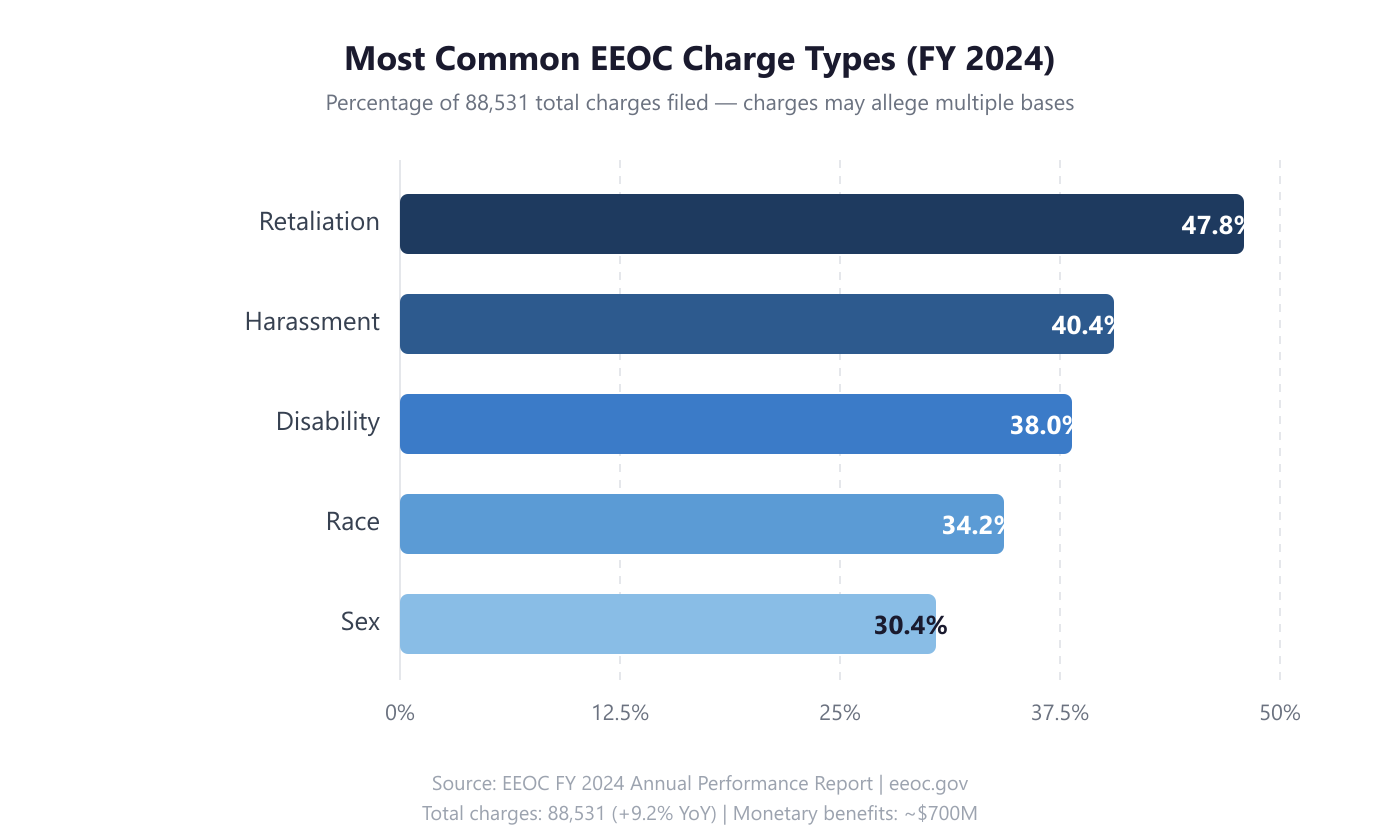
Retaliation is the most common employment claim in the United States, accounting for 47.8% of all EEOC charges in FY 2024, followed by harassment at 40.4%, disability discrimination at 38.0%, race discrimination at 34.2%, and sex discrimination at 30.4% (CWC, 2025). Since many charges allege multiple bases, these percentages total more than 100%.
Before contacting any lawyer, identify which category your situation falls into. Different employment issues require different legal specializations, and the right match can significantly affect your outcome.
Common California employment claims include:
- Workplace discrimination (race, sex, age, disability, religion, national origin)
- Sexual or workplace harassment
- Wrongful termination or retaliation
- Wage theft and minimum wage violations
- FMLA and CFRA leave violations
- Breach of employment contract or severance disputes
Each claim type carries different settlement ranges. Age discrimination cases in California average $150,000–$1,000,000, while retaliation claims typically settle for $20,000–$40,000 (LawLinq, 2025). Understanding your claim type helps you set realistic expectations and find a lawyer whose experience aligns with your needs.
Why Does Specialization Matter in Employment Law?
Workers who hire an attorney for wrongful termination cases receive an average settlement of $48,800 — more than 2.5 times the $19,200 average for those who represent themselves (LawLinq, 2025). Beyond having any lawyer, finding one who specializes in your specific claim type can further improve your outcome.
Employment law is broad. A lawyer who focuses on wage-and-hour disputes may not have the same depth of experience handling a complex disability discrimination case. When evaluating attorneys, ask how many cases similar to yours they’ve handled in the past two to three years.
Look for specialization in areas such as:
- Workplace harassment and hostile work environment claims
- Minimum wage and overtime violations
- Wage theft and unpaid compensation
- Wrongful termination based on discrimination or retaliation
- FMLA and CFRA violations
- Whistleblower retaliation
Whistleblower retaliation cases, for example, carry an average settlement value of approximately $447,830 — but only when handled by attorneys experienced in this niche area (LawLinq, 2025). A general practice attorney is unlikely to achieve the same result.
How Do You Verify a Lawyer’s Credentials in California?
The State Bar of California received 21,205 complaints against attorneys in FY 2025 and ultimately disciplined 154 of them — including 69 disbarments and 58 suspensions (State Bar of California, 2025). Checking your potential lawyer’s standing before hiring them takes five minutes and can prevent serious problems.
Start with the State Bar of California’s online lookup tool. You can verify that the attorney holds an active license, check for any past disciplinary actions, and confirm how long they’ve been practicing. An attorney with a clean record and 5+ years of employment law experience is generally a solid starting point.
Professional associations that indicate specialization include:
- California Employment Lawyers Association (CELA)
- National Employment Lawyers Association (NELA)
- American Bar Association (ABA) — Labor and Employment Law Section
- Local county bar associations with employment law committees
Membership in CELA or NELA is particularly meaningful because these organizations focus exclusively on representing employees in workplace disputes. Members must meet ongoing education requirements, which keeps them current on evolving California labor laws.
How Can You Assess a Lawyer’s Track Record?
Hiring a lawyer with a strong track record matters measurably: workers with legal representation have a 64% likelihood of receiving compensation in wrongful termination cases, compared to just 30% for those without an attorney (LawLinq, 2025). Past results don’t guarantee future outcomes, but they reveal whether an attorney can successfully navigate cases like yours.
Ask potential lawyers about the number of employment cases they’ve handled, their settlement success rate, and whether they’ve taken similar cases to trial. Attorneys who only settle and never go to trial may have less leverage during negotiations.
When reviewing an attorney’s track record, focus on:
- Number of employment cases handled in the past 3–5 years
- Settlement success rates and average amounts recovered
- Trial experience (even if most cases settle, trial readiness adds leverage)
- Experience with your specific claim type
Client reviews on platforms like Google, Avvo, and Martindale-Hubbell provide real-world feedback. Look for patterns rather than individual reviews — consistent praise for responsiveness and clear communication usually indicates a well-run practice. Consistent complaints about delays or poor communication are red flags to take seriously.

What Questions Should You Ask During a Free Consultation?
Most California employment lawyers offer free initial consultations, especially those who work on contingency — meaning they only get paid if you win. The EEOC secured $469.6 million for 13,516 workers through settlements in FY 2024 (EEOC, 2024), and a strong consultation helps you determine whether your case has similar potential.
Treat the consultation as a two-way interview. You’re evaluating the lawyer’s expertise and communication style just as much as they’re evaluating your case. Come prepared with documents and specific questions.
Questions to ask during your consultation:
- How many cases like mine have you handled, and what were the outcomes?
- What is your strategy for my specific situation?
- What are the potential challenges or weaknesses in my case?
- How will you communicate updates — email, phone, client portal?
- What is your fee structure, and are there any costs I’ll owe regardless of outcome?
- How long do cases like mine typically take to resolve?
- Will you personally handle my case, or will it be assigned to a junior associate?
Pay attention to how they answer. Vague responses or guarantees of specific outcomes are warning signs. A good employment lawyer explains the strengths and risks of your case honestly, without overpromising.
How Much Does a California Employment Lawyer Cost?
Most California employment lawyers who represent employees work on contingency fees ranging from 30% to 40% of the settlement or judgment, meaning you pay nothing out of pocket unless you win (Novian & Novian, 2025). Hourly rates, used less commonly for plaintiff-side employment cases, range from $200 to $600 per hour in California (Kramer Brown Hui, 2025).
Understanding the fee structure before signing a retainer agreement prevents surprises. Always ask about additional costs beyond the attorney’s fee.
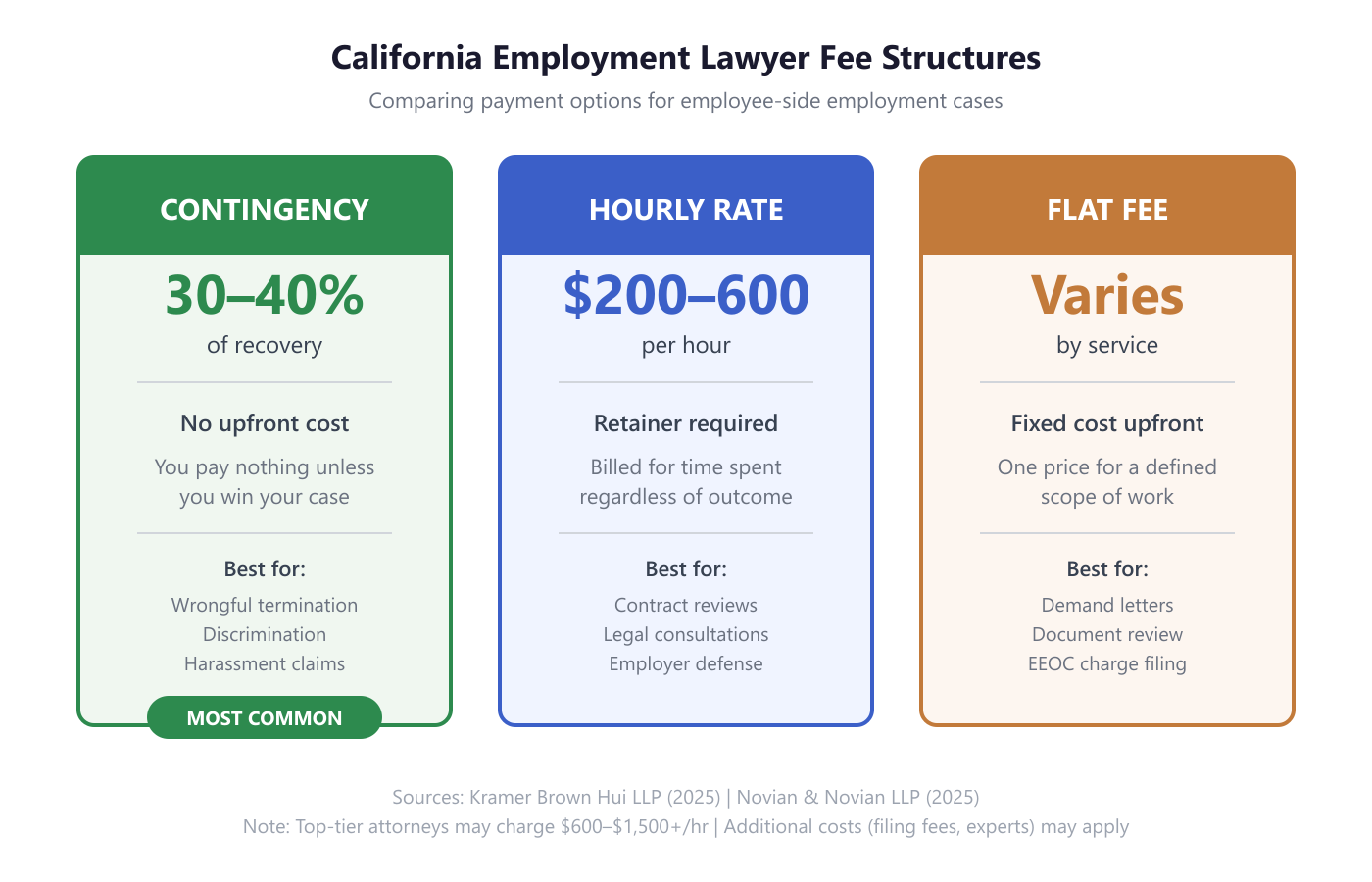
Common fee structures for California employment lawyers:
| Fee Type | Typical Range | Best For |
|---|---|---|
| Contingency | 30%–40% of recovery | Wrongful termination, discrimination, harassment |
| Hourly | $200–$600/hr | Contract reviews, legal advice, employer defense |
| Flat fee | Varies by service | Demand letters, document review, EEOC charge filing |
With contingency arrangements, the lawyer absorbs the risk: if you don’t recover compensation, you don’t owe legal fees. However, some agreements still require you to cover court filing fees, expert witness costs, or administrative expenses — which can range from a few hundred to several thousand dollars. Read the fee agreement carefully before signing.
How Do You Know If a Lawyer Is the Right Fit?
The EEOC handled 553,000 calls and 248,255 in-person inquiries from workers in FY 2024 (EEOC, 2024) — illustrating how many employees face workplace issues and need clear, responsive legal guidance. When you’re one of those workers, your lawyer’s communication style and accessibility directly affect your experience.
Employment cases often involve sensitive topics: harassment, discrimination, retaliation. You need to feel comfortable sharing details that may be difficult to discuss. If the attorney feels dismissive, rushed, or unclear during the initial consultation, that dynamic is unlikely to improve once you’re a client.
Evaluate these fit factors:
- Responsiveness: Do they return calls and emails within 24–48 hours?
- Clarity: Can they explain legal concepts in plain language?
- Honesty: Do they address weaknesses in your case, not just strengths?
- Availability: Who handles your case day-to-day — the attorney or support staff?
- Respect: Do they listen to your concerns and answer your questions fully?
Trust your instincts during the evaluation. If something feels off, it’s worth consulting one or two additional attorneys before committing. Most offer free consultations, so there’s no financial cost to meeting with multiple lawyers before making a decision.
What Red Flags Should You Watch For?
With 21,205 complaints filed against California attorneys in a single year and 154 resulting in discipline (State Bar of California, 2025), problematic lawyers do exist. Knowing the warning signs before you hire helps you avoid becoming one of those complainants.
The most common red flags fall into three categories: transparency problems, communication failures, and unrealistic promises.
Warning signs to watch for:
- Guaranteed outcomes: No ethical lawyer can promise a specific result. If they guarantee you’ll win or quote a specific dollar amount before investigating your case, walk away.
- Vague fee discussions: Unwillingness to put fee terms in writing or explain exactly what you’ll owe is a serious red flag.
- Poor responsiveness: If they take days to return calls during the consultation phase — when they’re trying to win your business — expect worse once you’re a client.
- Pressure tactics: Lawyers who push you to sign immediately or claim your case is “time-sensitive” without explaining the actual statute of limitations may not have your best interests in mind.
- Disciplinary history: Always check the State Bar’s public records for past actions.
The average disciplinary case takes 131 days to process through the State Bar system (State Bar of California, 2025). If a lawyer has active complaints pending, that information may not yet be reflected in public records — another reason to rely on multiple evaluation methods, including reviews and professional references.
How Should You Prepare for Your First Meeting?
The EEOC filed 111 lawsuits on behalf of workers in FY 2024, achieving a 97% success rate in resolved merits cases (EEOC, 2024). While most employment disputes don’t reach that level, thorough preparation from the very first meeting gives your case the strongest possible foundation — whether it settles early or goes to trial.
Organize your materials before the consultation. The more complete your documentation, the faster your attorney can evaluate your case and develop a strategy.
Bring these documents to your first meeting:
- Employment contract, offer letter, and any amendments
- Recent pay stubs and records of hours worked
- Written communications (emails, texts, Slack messages) related to your complaint
- Performance reviews from the past 2–3 years
- Any written complaints you’ve filed with HR, along with HR’s responses
- Notes on key events with dates, names, and locations
- Contact information for potential witnesses
Write a brief timeline of events before the meeting — what happened, when, and who was involved. This helps your attorney quickly understand the sequence and identify the strongest legal claims. Keep it factual and chronological rather than emotional.
Frequently Asked Questions
What types of cases do California employment lawyers handle?
California employment lawyers handle workplace discrimination, harassment, wrongful termination, retaliation, wage theft, overtime violations, and FMLA/CFRA leave disputes. Retaliation is the most common claim nationally, representing 47.8% of all EEOC charges in FY 2024 (CWC, 2025). Many California cases also involve state-specific protections under the Fair Employment and Housing Act (FEHA).
How much does it cost to hire an employment lawyer in California?
Most employment lawyers representing employees work on contingency fees of 30%–40% of the recovery, so you pay nothing unless you win (Novian & Novian, 2025). Hourly rates for California employment attorneys range from $200 to $600 per hour when hourly billing applies (Kramer Brown Hui, 2025). Some attorneys charge flat fees for discrete tasks like demand letters or contract reviews.
How do I know if I need an employment lawyer?
Consider hiring a lawyer if you’ve experienced illegal treatment at work — such as discrimination, harassment, wrongful termination, or wage theft — and your employer hasn’t resolved it through internal channels. Workers with legal representation have a 64% chance of receiving compensation in wrongful termination cases, compared to 30% without a lawyer (LawLinq, 2025). Free consultations let you evaluate your case without financial commitment.
How long does a California employment lawsuit take?
Most California employment cases resolve in 6 to 18 months, though complex litigation can take 2–3 years. Cases that settle during mediation — which had a 71% success rate through the EEOC in FY 2024 (EEOC, 2024) — typically resolve faster than those that go to trial. Your attorney can provide a more specific timeline based on your claim type and jurisdiction.
What is the average settlement for an employment case in California?
Average settlements vary widely by claim type. Wrongful termination cases with legal representation average $48,800, while whistleblower retaliation cases average approximately $447,830 (LawLinq, 2025). Disability discrimination settlements range from $25,000 to $500,000, and age discrimination cases from $150,000 to $1,000,000, depending on the facts and damages involved.
Take the Next Step
The EEOC received over 88,500 workplace discrimination charges in FY 2024 — and recovered nearly $700 million for workers (EEOC, 2024). If you’re facing an employment dispute in California, having the right lawyer significantly improves your chances of a fair outcome.
Start by identifying your claim type, researching attorneys who specialize in that area, and scheduling free consultations with two or three candidates. Verify credentials through the State Bar, compare fee structures, and choose the lawyer who combines relevant experience with clear, responsive communication.
If you are having legal issues with your employer, reach out to California Labor Law by calling us at 1-866-355-9991 for a free employment law consultation.
Last updated: February 2026