




California Overtime Rules 2026: Rates, Exemptions & What You’re Owed
Working extra hours at a California retail store or hospitality venue should come with reliable pay, but many employees face confusion over the rules.
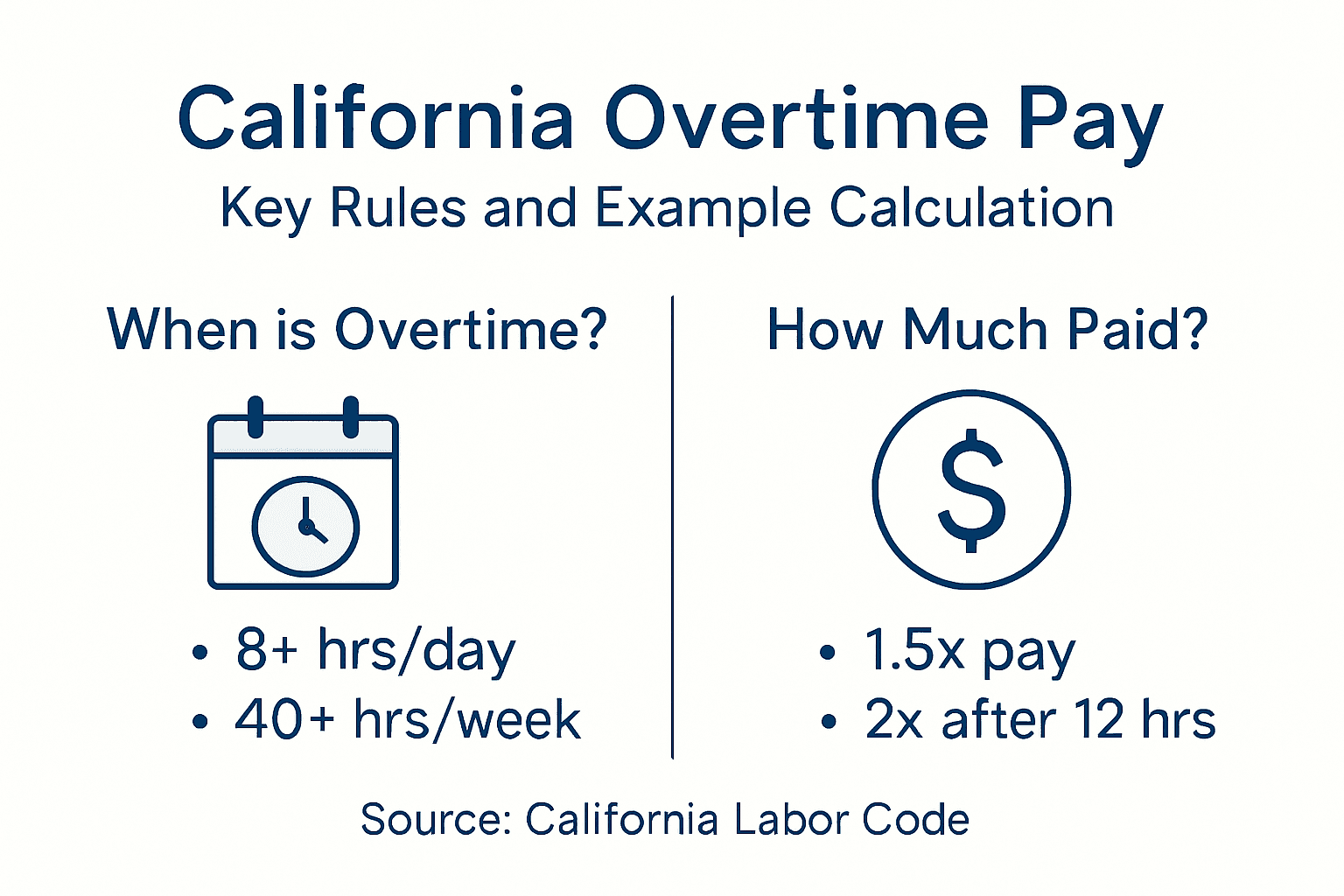
California law requires most nonexempt workers to receive overtime pay for any hours beyond eight in a day or forty in a week, and double pay for shifts lasting over twelve hours.
If paychecks do not reflect these hard-earned hours, understanding your correct rights and classifications can be the key to protecting your income.
California Overtime Pay: Core Definitions
Understanding overtime pay in California requires knowing precise legal definitions that protect workers’ rights. California Labor Code establishes clear guidelines for compensating employees beyond standard work hours, creating a robust framework for wage protection.
At its core, California overtime law mandates specific compensation rates for nonexempt employees who work extended hours. The key overtime definitions include:
- Regular Rate: Total compensation including base wage, commissions, and certain bonuses
- Overtime Threshold: Hours worked beyond 8 per day or 40 per week
- Overtime Rates:
- 1.5x regular pay for hours worked over 8 in a single day
- 1.5x regular pay for hours worked over 40 in a workweek
- 2x regular pay for hours worked over 12 in a single day
Important exemptions exist for certain professional categories, including executive, administrative, and professional employees who meet specific salary and job duty requirements. Overtime calculation rules can vary depending on an employee’s specific job classification and industry.
Pro tip: Always track your hours meticulously and understand your specific employment classification to ensure you receive proper overtime compensation.
Eligibility Rules for Overtime Pay
Determining overtime pay eligibility is crucial for workers in California, as not all employees qualify for additional compensation. Employee classification rules create a complex framework that defines who receives overtime pay and under what circumstances.
California’s overtime eligibility typically depends on several key factors:
- Wage Threshold: Employees must earn less than twice the state minimum wage
- Job Classification: Nonexempt employees in most industries are eligible
- Work Hours: Hours worked beyond 8 per day or 40 per week qualify for overtime
Specific exemption categories include:
- Executive employees with significant management responsibilities
- Administrative professionals performing specialized office work
- Professional workers in specialized fields
- Computer professionals meeting specific salary requirements
- Outside salespersons with mobile work arrangements
Unique rules apply to certain worker categories. Agricultural workers, domestic employees, and union members might have different overtime standards compared to standard industry workers.
Independent contractors are typically not eligible for overtime pay, making proper job classification critical.
Here’s a quick reference comparing common employee categories and their overtime eligibility in California:
| Employee Category | Overtime Eligible | Key Determining Factor |
|---|---|---|
| Nonexempt Employees | Yes | Paid hourly or salary under threshold |
| Executive Employees | No, usually exempt | Management duties, salary requirements |
| Computer Professionals | Sometimes exempt | Salary plus specialized job duties |
| Independent Contractors | No | Not classified as employees |
California’s overtime laws aim to protect workers by ensuring fair compensation for extended work hours.
Pro tip: Carefully review your job classification and employment contract to understand your specific overtime eligibility and potential compensation.
How Overtime Wages Are Calculated
Calculating overtime wages in California involves a precise method that goes beyond simple hourly multiplication. Overtime calculation rules require employers to consider multiple components of an employee’s compensation when determining overtime pay.
The basic overtime calculation relies on the employee’s regular rate of pay, which encompasses more than just standard hourly wages. This comprehensive rate includes:
- Base hourly wage
- Commissions
- Piece-rate earnings
- Non-discretionary bonuses
- Other forms of compensation
Overtime rates in California follow these specific multipliers:
- 1.5x regular rate for hours worked over 8 in a single day
- 1.5x regular rate for hours exceeding 40 in a workweek
- 2x regular rate for hours worked beyond 12 in a single day
- 2x regular rate for the eighth hour worked on a seventh consecutive workday
Complex scenarios can arise with varied pay structures, particularly for employees with multiple compensation types. Workers with commission-based or variable earnings must have their regular rate calculated carefully to ensure accurate overtime compensation.
Pro tip: Keep detailed records of all hours worked and different compensation types to ensure accurate overtime calculation and protect your wage rights.
Legal Overtime Exemptions and Exceptions
Understanding overtime exemptions in California requires careful examination of specific legal criteria. Exemption rules create a complex framework that determines which employees are not entitled to overtime compensation.
The primary categories of overtime exemptions include:
- Executive Employees: Those with significant management responsibilities
- Administrative Professionals: Performing specialized office work
- Professional Workers: Requiring advanced specialized knowledge
- Computer Professionals: Meeting specific salary and job duty requirements
- Outside Salespersons: With mobile work arrangements
Key requirements for exempt status typically involve:
- Earning at least twice the state minimum wage
- Performing primarily intellectual or creative work
- Exercising independent judgment
- Spending more than 50% of work time on exempt duties
Special considerations apply to unique worker categories. Agricultural workers, domestic employees, and union members often have different overtime standards. Some industries have specific exceptions that modify standard overtime rules, making it crucial for workers to understand their specific classification.
Not all employees who receive a salary are automatically exempt from overtime pay.
Pro tip: Carefully review your job description and actual job duties, as your official title may not always determine your overtime eligibility.
Employer Responsibilities and Penalties
Employers in California face substantial legal obligations when it comes to overtime compensation. Overtime compliance requirements create a strict framework of responsibilities that can result in significant financial consequences for violations.
Key employer responsibilities include:
- Accurately tracking employee work hours
- Calculating overtime rates correctly
- Maintaining comprehensive payroll records
- Providing clear overtime pay on regular pay schedules
- Compensating employees for all overtime worked
Potential penalties for overtime violations can be severe and may include:
- Payment of back wages with interest
- Civil penalties up to $100 per pay period
- Additional damages equal to the unpaid overtime
- Potential criminal prosecution for repeated violations
- Legal costs and attorney fees
The complexity of overtime regulations means employers must be vigilant. Small mistakes in record-keeping or payment calculations can quickly escalate into costly legal challenges. Workers have multiple avenues to report violations, including filing complaints with the California Labor Commissioner’s Office or pursuing private lawsuits.
This table summarizes selected employer mistakes and the associated legal risks regarding overtime:
| Employer Mistake | Possible Consequence | Legal Risk Level |
|---|---|---|
| Inaccurate hour tracking | Back pay, penalties | High |
| Misclassifying employees | Owed overtime, lawsuits | High |
| Late overtime payment | Interest, extra damages | Medium |
| Incomplete payroll records | Civil fines, compliance issues | Medium to High |
Consistent and accurate overtime compliance is not optional – it’s a legal requirement.
Pro tip: Implement robust time-tracking systems and regularly audit payroll practices to minimize the risk of unintentional overtime violations.
Know Your Rights and Secure Every Overtime Dollar You Deserve
California workers often face confusion and frustration when it comes to understanding overtime pay eligibility and proper calculation. If you have ever worried about whether your hours are tracked correctly or questioned if your job classification affects your overtime pay your concerns are valid.
Misclassification and inaccurate pay calculations can lead to lost wages and missed opportunities to claim what you rightfully earned under California labor law.
Explore our detailed guides and use our calculators to determine if your employer is meeting legal obligations. Don’t let improper overtime pay go unchecked take immediate action to protect your rights and claim the wages owed to you.
Call 1-866-355-9991 now for a free overtime pay consultation and get connected to legal advocates ready to support your case. Your fair pay matters and now is the time to stand up for it.
Frequently Asked Questions
What is the overtime threshold in California?
The overtime threshold in California is defined as hours worked beyond 8 hours in a single day or 40 hours in a workweek. Any hours over these limits are eligible for overtime pay.
How is overtime pay calculated in California?
Overtime pay in California is calculated by taking the employee’s regular rate of pay, which includes base wage, commissions, and certain bonuses, and multiplying it by 1.5 for hours worked over 8 hours in a day or 40 hours in a week. For hours worked over 12 in a day, the rate is doubled.
Who is eligible for overtime pay in California?
Eligibility for overtime pay in California generally applies to nonexempt employees who earn less than twice the state minimum wage, work in most industries, and work beyond 8 hours in a day or 40 hours in a week. Certain exemptions apply to executive, administrative, and professional employees.
What are the penalties for employers who violate overtime pay laws?
Employers who violate overtime pay laws may face severe penalties, including the payment of back wages with interest, civil penalties up to $100 per pay period, additional damages equal to unpaid overtime, and potential criminal prosecution for repeated violations.