




California Overtime Pay Rules: Your Rights Under the FLSA and California Law
Working extra hours without proper pay is a reality for thousands of hourly employees, especially in California retail and service jobs. With overtime violations so common, many workers miss out on compensation the law guarantees.
Understanding the Fair Labor Standards Act and how California laws provide even greater overtime protection helps you spot wage theft early and learn the steps to get the pay you deserve.
What Is Fair Labor Standards Act Overtime?
The Fair Labor Standards Act (FLSA) establishes crucial overtime regulations that protect workers across the United States, including employees in California. At its core, the FLSA mandates that eligible employees receive additional compensation when they work more than 40 hours in a single workweek.
Overtime provisions require employers to pay workers at least one and a half times their standard hourly rate for any hours worked beyond the standard 40-hour threshold.
Under the FLSA, overtime calculations are based on a specific workweek definition, which is a fixed and recurring period of 168 hours (seven consecutive 24-hour periods). This means overtime is not automatically triggered by working on weekends or holidays, but specifically when an employee exceeds 40 hours within their designated workweek. The Act applies to most hourly workers and some salaried employees, though certain job classifications and industries may have specific exemptions from these overtime requirements.
California workers should understand that while the FLSA provides a federal baseline for overtime pay, the state often has additional protections that can be more generous to employees. For instance, California law requires overtime pay for work beyond 8 hours in a single day, which provides more comprehensive coverage than the federal standard. Employers must comply with whichever law (federal or state) provides the greatest benefit to the employee.
Pro tip: Keep detailed records of all hours worked, including any overtime, to ensure you can accurately verify your compensation and protect your wage rights.
California vs. Federal Overtime Regulations
California has established some of the most worker-friendly overtime regulations in the United States, significantly expanding upon the federal Fair Labor Standards Act (FLSA) protections.
Overtime laws in California go far beyond federal requirements, providing more comprehensive compensation for workers across various industries. While the federal standard only mandates overtime pay for hours worked beyond 40 in a workweek, California requires overtime compensation for hours worked beyond 8 in a single day.
The key differences between federal and California overtime regulations are substantial. Under federal FLSA guidelines, employees receive one and a half times their regular pay rate for hours exceeding 40 in a workweek. California, however, introduces additional protections: workers earn overtime for daily hours over 8, with double time for hours worked beyond 12 in a single day. This means California workers can potentially earn significantly more overtime compensation compared to the federal baseline, especially during extended work shifts or consecutive workdays.
Employers operating in California must carefully navigate these complex regulations. When federal and state laws differ, employers are legally required to follow the standard that provides the greatest benefit to employees. This typically means applying California’s more stringent overtime rules, which offer more robust worker protections. Specific industries and job classifications may have unique exemptions, making it crucial for both employers and employees to understand the nuanced differences between federal and state overtime regulations.
Pro tip: Always document your work hours meticulously and understand your specific industry’s overtime classifications to ensure you receive proper compensation.
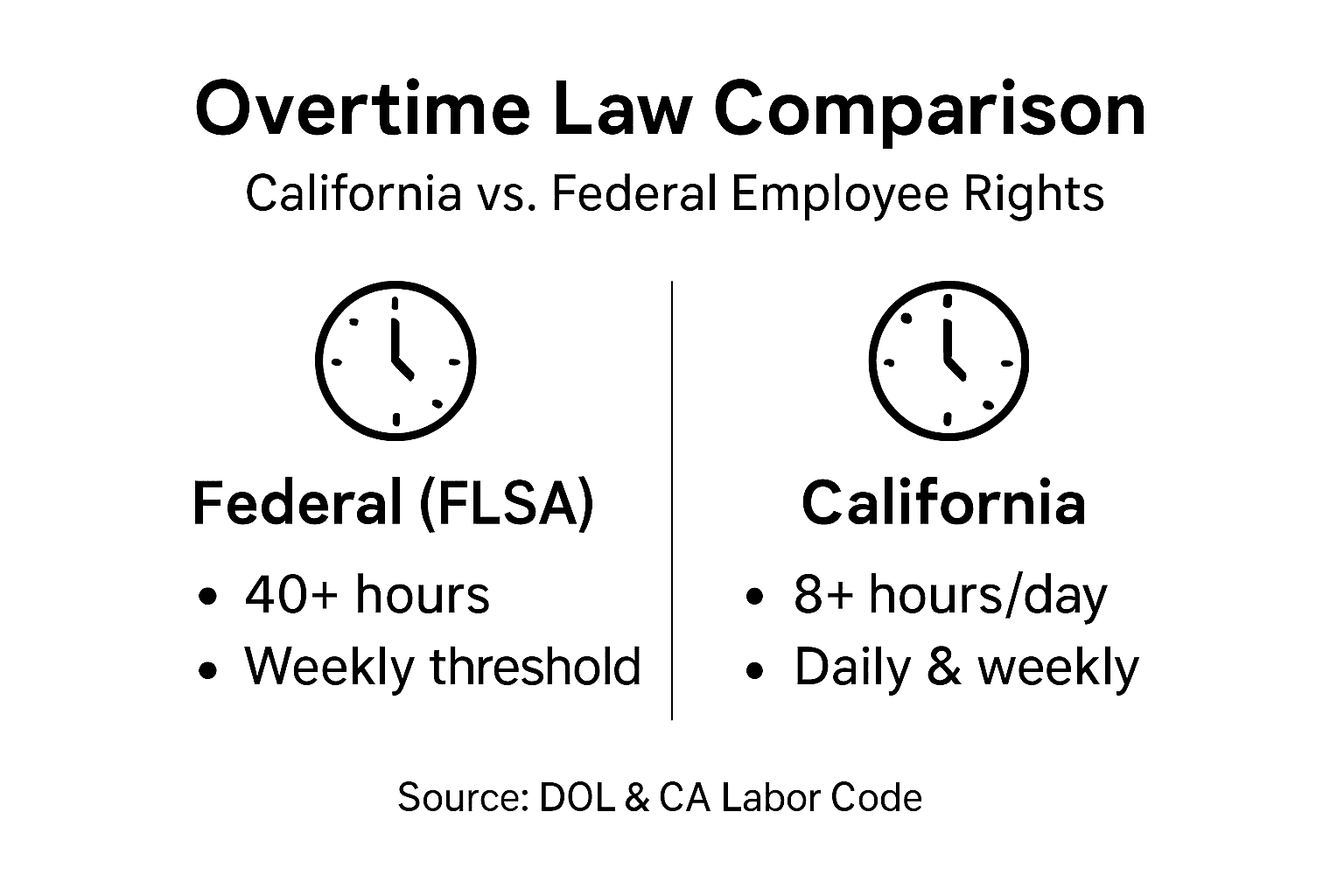
Here’s a side-by-side comparison of federal and California overtime rules:
| Aspect | Federal (FLSA) Requirement | California State Requirement |
|---|---|---|
| Overtime Weekly Trigger | Over 40 hours in a workweek | Over 40 hours in a workweek |
| Overtime Daily Trigger | No daily overtime | Over 8 hours in a single day |
| Double Time Provision | Not required | Over 12 hours in a day, or 7th day in week |
| Exemptions | Broader, based on job duties/salary | More limited, stricter job duty standards |
| Rate for Overtime Hours | 1.5× regular hourly rate | 1.5× after 8 hrs, 2× after 12 hrs/day |
Eligibility and Exemption from Overtime Pay
Understanding overtime eligibility is crucial for California workers seeking fair compensation. Overtime exemption rules are complex, with specific criteria determining whether an employee qualifies for additional pay. Most employees are eligible for overtime, but certain job classifications are exempt based on salary level, job duties, and specific industry standards. The primary categories of exempt employees typically include executive, administrative, professional, outside sales, and some computer professionals.
To qualify for an overtime exemption, employees must meet stringent tests beyond their job title. The key requirements include receiving a predetermined salary above a specific threshold and performing primarily executive, administrative, or professional duties that require independent judgment.
For instance, a manager must not only have a supervisory title but also spend a majority of their time making significant company decisions and directly managing other employees. Commissioned sales representatives and certain specialized technology workers may also fall under exemption categories, provided they meet specific salary and responsibility criteria.
California employers must carefully navigate these intricate regulations, as misclassifying employees can result in significant legal and financial penalties. The state often applies more stringent standards than federal guidelines, meaning an employee might be nonexempt under California law even if they appear exempt under federal regulations.
Factors such as the nature of work, level of independent decision-making, and specific job responsibilities play critical roles in determining overtime eligibility. Workers who believe they have been improperly classified should document their job duties and consult with employment law professionals.
Pro tip: Review your job description carefully and track your actual daily responsibilities to determine whether you might have been incorrectly classified as exempt from overtime pay.
How Overtime Is Calculated in California
California’s overtime calculation rules are significantly more complex and employee-friendly compared to federal standards. California overtime laws establish a comprehensive framework that protects workers by mandating premium pay rates for extended work hours. Unlike the federal standard which only requires overtime after 40 hours in a workweek, California requires overtime compensation for hours worked beyond 8 in a single day and calculates overtime on both daily and weekly work periods.

The specific overtime calculation methods in California involve multiple rate tiers. Employees receive 1.5 times their regular hourly rate for hours worked beyond 8 in a day or 40 in a week. In more demanding work scenarios, workers are entitled to double their regular rate for hours exceeding 12 in a single day or for work performed on the seventh consecutive day of a workweek. This means an employee working a 10-hour shift would receive their standard rate for the first 8 hours, 1.5 times their rate for the next 2 hours, and double their rate for the final hour.
Employers must carefully track and calculate these nuanced overtime provisions, considering both daily and weekly thresholds. The calculations require precise record-keeping of actual hours worked, including start and end times for each shift.
Factors such as meal breaks, rest periods, and total hours in a workweek can significantly impact overtime calculations. Workers should maintain their own detailed time records to verify that employers are correctly applying California’s stringent overtime regulations, which often provide more substantial compensation than federal guidelines.
Pro tip: Maintain a personal log of your daily work hours, including start and end times, to cross-reference against your paycheck and ensure accurate overtime calculations.
Common Overtime Violations and Worker Rights
Overtime violations remain a persistent problem for California workers, with employers frequently attempting to circumvent fair compensation regulations. Labor law enforcement reveals several critical patterns of wage theft that employees should vigilantly watch for. The most common violations include misclassifying employees as exempt to avoid overtime payments, failing to compensate for all hours worked, and deliberately undercalculating overtime rates.
Employees face numerous specific overtime violation scenarios that compromise their wage rights. These include managers pressuring workers to work off the clock, deliberately manipulating time records, refusing to pay overtime rates for work performed beyond standard hours, and incorrectly classifying workers as independent contractors to sidestep overtime requirements. Some employers strategically create policies that discourage workers from reporting overtime hours or create complex scheduling systems designed to obscure actual worked time.
California provides robust legal protections for workers facing overtime violations. Employees have the right to file complaints with the Labor Commissioner’s Office, seek wage recovery for unpaid overtime, and pursue legal action against employers who violate overtime regulations.
The state’s laws are intentionally structured to protect workers, allowing recovery of unpaid wages, penalties, and potential additional compensation for willful violations. Workers should document all work hours meticulously, understand their classification, and be prepared to assert their legal rights when confronted with potential overtime violations.
Pro tip: Photograph or digitally screenshot your work time records and keep a contemporaneous personal log of all hours worked to provide concrete evidence if you need to challenge overtime violations.
Seeking Help for Unpaid Overtime Issues
Workers confronting unpaid overtime face multiple avenues for seeking justice and recovering lost wages. Workers’ rights resources provide comprehensive guidance for employees navigating wage theft complaints. The California Labor Commissioner’s Office offers a structured process for filing wage claims, with multilingual support to ensure accessibility for diverse worker populations. Employees can initiate formal complaints detailing specific instances of unpaid overtime, including documentation of hours worked and compensation records.
The legal recourse for unpaid overtime involves several strategic steps. Workers can file administrative wage claims directly with the Labor Commissioner’s Office, which investigates wage violations and can order employers to pay owed compensation.
Alternatively, employees may choose to pursue civil lawsuits, potentially recovering not just unpaid wages but also additional penalties and legal costs. Some workers opt to seek assistance from employment law attorneys who specialize in wage and hour disputes, providing expert guidance through complex legal proceedings.
Documentation serves as the critical foundation for successful overtime claims. Workers should meticulously preserve time sheets, pay stubs, work schedules, email communications, and any other evidence demonstrating hours worked and compensation discrepancies.
Legal aid organizations and worker advocacy groups can provide free consultations and guidance, helping employees understand their rights and the most effective strategies for recovering unpaid overtime. The law protects workers from employer retaliation, ensuring that employees can assert their wage rights without fear of professional consequences.
Pro tip: Create a comprehensive digital and physical file containing all employment documentation, including time records, pay stubs, and correspondence, to strengthen your potential overtime claim.
The table below summarizes key steps to address unpaid overtime issues:
| Action Step | Purpose | Recommended Documentation |
|---|---|---|
| Track all work hours | Ensure accurate overtime claim | Time sheets, logs, clock records |
| Preserve payment records | Prove underpayment or wage theft | Pay stubs, direct deposit statements |
| File complaint with Labor Office | Start official recovery process | Complaint form, supporting evidence |
| Seek legal advice | Navigate complex disputes | Consultation notes, legal letters |
Protect Your Right to Fair Overtime Pay in California
Navigating the complex landscape of Fair Labor Standards Act overtime rules alongside California’s stricter state regulations can be overwhelming. If you’ve experienced unpaid or miscalculated overtime, been misclassified as exempt, or just want to understand your rights better, you are not alone. The pain of working extra hours without fair compensation is a reality for many California workers, but you do not have to accept it silently.
At California Labor Law, we provide clear, trusted guidance on your overtime rights under both federal and California laws. Our free legal resources help you track your hours properly, recognize potential violations, and empower you to take confident action.
Don’t wait until your wage loss grows. Learn how to use overtime pay rules to your advantage and get direct access to legal support tailored specifically for California employees. Protect what you have earned today by calling 1-866-355-9991 to schedule a free overtime pay consultation and start asserting your rights now.
Frequently Asked Questions
What is the Fair Labor Standards Act (FLSA) overtime rule?
The FLSA mandates that eligible employees receive overtime pay of at least one and a half times their regular hourly rate for any hours worked over 40 in a single workweek.
How does California’s overtime law differ from federal law?
California law requires overtime pay for hours worked beyond 8 in a single day, in addition to the federal requirement of overtime for hours over 40 in a week, making it more beneficial for workers.
Who is exempt from overtime pay under California law?
Exempt employees typically include those in executive, administrative, professional roles, and some outside sales positions. They must meet specific salary thresholds and job duties to qualify for exemption.
How is overtime calculated in California?
Overtime in California is calculated at 1.5 times the regular pay rate for hours worked over 8 in a day or 40 in a week, and workers receive double time for hours exceeding 12 in a day or for working the seventh consecutive day.