




California Worker Rights: Independent Contractor vs Employee Explained
Gig work offers freedom and flexibility, but many in California are left guessing about their true status on the job. The difference between being classified as an employee or an independent contractor shapes access to pay protections, benefits, and recourse against wage theft.
This overview breaks down the critical differences—including the ABC Test and legal updates like AB 5—so you can understand your rights and protect your income.
Defining Employees And Independent Contractors
Understanding the distinction between employees and independent contractors is critical in California, where legal definitions can significantly impact worker rights and employer responsibilities. California’s legal framework provides clear guidelines for distinguishing these worker classifications based on multiple factors.
The primary differentiator between employees and independent contractors lies in the level of control and independence within the working relationship.
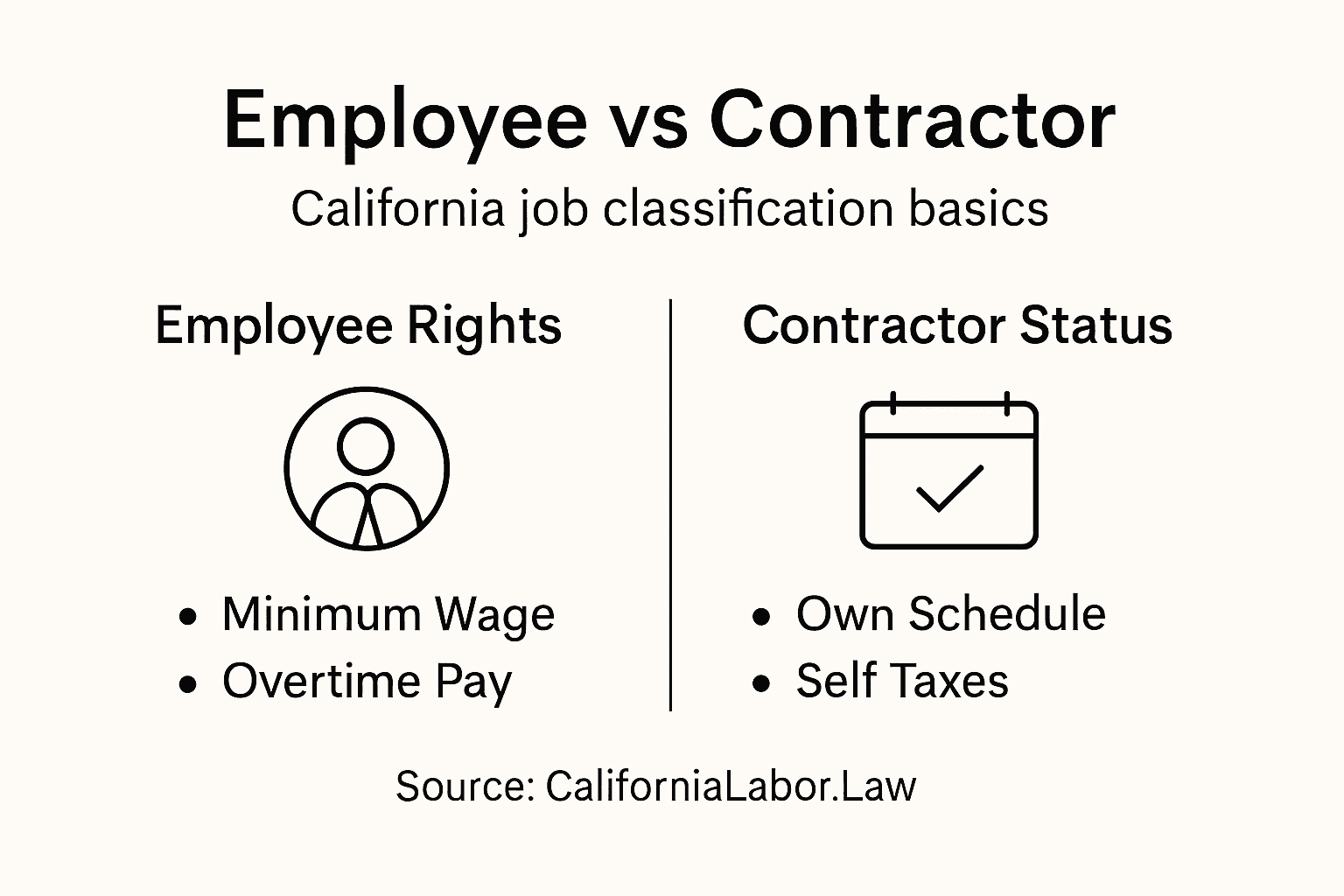
Employees are typically under direct supervision, receive consistent wages, have taxes withheld, and are provided workplace benefits like health insurance and retirement plans.
Independent contractors, conversely, operate with significant autonomy, use their own tools, set their own schedules, work for multiple clients, and are responsible for their own taxes and business expenses.
California applies the ABC Test to determine worker classification, which requires three key conditions to be met for a worker to be considered an independent contractor:
- The worker is free from the control and direction of the hiring entity
- The worker performs work outside the usual course of the hiring entity’s business
- The worker is customarily engaged in an independently established trade, occupation, or business
Pro tip: Always document your working relationship in writing and maintain clear records of your work arrangement to protect your legal classification and rights.
Here’s a direct comparison of employees and independent contractors in California:
| Aspect | Employee Status | Independent Contractor Status |
|---|---|---|
| Tax Withholding | Employer handles taxes | Worker manages and pays own taxes |
| Benefits | Access to health, retirement | No employer-provided benefits |
| Work Schedule | Fixed and directed by employer | Chosen independently by contractor |
| Legal Protections | Covered by labor laws | Limited legal safeguards |
| Financial Stability | Predictable income, paychecks | Variable income, project-based pay |
Worker Classification Tests In California
California employs rigorous legal tests to determine worker classification, with the ABC Test emerging as the primary standard for distinguishing between employees and independent contractors.
Introduced through the landmark Dynamex Operations West, Inc. v. Superior Court decision and subsequently codified in Assembly Bill 5 (AB 5), this test shifts the burden of proof onto employers to demonstrate that a worker is truly an independent contractor.
The ABC Test requires employers to prove three critical conditions simultaneously. First, the worker must be free from the company’s control and direction in performing work. Second, the worker must perform work outside the usual course of the hiring entity’s business.
Third, the worker must be customarily engaged in an independently established trade, occupation, or business of the same nature as the work performed. These stringent requirements make it challenging for businesses to classify workers as independent contractors, effectively providing stronger protections for workers.
Before the ABC Test, California utilized the Borello Test, a more flexible multifactor approach that considered various aspects of the working relationship.
While the Borello Test remains applicable in certain situations, such as specific industry exceptions, the ABC Test has become the predominant method for worker classification.
Factors examined under the Borello Test included the degree of control, whether the worker could work for multiple employers, who provided tools and equipment, the skill required, and the method of payment.
Pro tip: Consult with a California employment lawyer to thoroughly review your specific work arrangement and understand the nuanced application of worker classification tests in your particular industry.
Below is an overview of major worker classification tests used in California:
| Test Name | Key Criteria Focus | Where Applied |
|---|---|---|
| ABC Test | Control, business type, independence | Most industries since 2020 |
| Borello Test | Level of control, payment method | Industry exemptions, select fields |
| Prop 22 Test | Work app platform status | App-based gig economy workers |
California AB 5 And Recent Legal Updates
Assembly Bill 5 (AB 5) fundamentally transformed worker classification in California, introducing stringent requirements that dramatically narrowed the definition of independent contractors. California’s landmark legislation effective January 1, 2020, codified the ABC test and created significant challenges for businesses relying on contract workers across multiple industries.
The bill established three critical criteria for classifying workers as independent contractors. Employers must prove that workers are free from company control, perform work outside the company’s primary business, and are independently established in their trade.
Numerous professional categories received specific exemptions, including:
- doctors,
- lawyers,
- real estate agents,
- architects,
- and certain creative professionals.
These exemptions acknowledged the unique nature of professional services that did not fit neatly into traditional employment models.
In a subsequent legal development, California’s Supreme Court upheld Proposition 22, which specifically addressed gig economy workers. This ruling preserved app-based drivers’ ability to maintain independent contractor status, creating a nuanced exception to AB 5’s broad restrictions.
The decision highlighted the ongoing tension between protecting worker rights and maintaining flexibility for emerging business models in the digital economy.
Pro tip: Consult an employment law specialist to understand how AB 5 specifically applies to your industry and work arrangement, as exemptions and interpretations can be complex and evolving.
Rights And Protections For Employees
California provides comprehensive legal protections for employees that create a robust safety net far beyond the limited rights afforded to independent contractors.
California labor standards ensure workers receive critical safeguards including minimum wage guarantees, overtime compensation, meal and rest breaks, and protection from workplace discrimination and harassment.

Employees are entitled to a wide range of statutory benefits that independent contractors cannot access. These protections include:
- mandatory workers’ compensation insurance,
- unemployment benefits,
- disability insurance,
- and comprehensive anti-discrimination laws.
Employers must provide a safe working environment, pay appropriate wages, and comply with state and federal regulations regarding workplace conditions. The legal framework also protects employees from retaliation when reporting workplace violations, ensuring workers can speak up without fear of losing their employment.
The financial and legal advantages of employee status extend beyond immediate compensation. Employees receive consistent paycheck withholdings for social security and Medicare, access to employer-sponsored health insurance, retirement plans like 401(k) matching, and predictable work schedules.
Independent contractors, by contrast, must manage their own tax obligations, healthcare costs, and retirement planning without employer support. These fundamental differences underscore the significant value of proper employee classification in protecting workers’ long-term economic stability.
Pro tip: Document and track all workplace interactions, pay stubs, and employment agreements to protect your rights and create a clear record in case of potential disputes.
Risks And Challenges For Independent Contractors
Workplace challenges for independent contractors in California extend far beyond the immediate lack of traditional employment benefits, creating a complex landscape of financial and legal vulnerabilities. Independent contractors must navigate a significantly different professional environment that demands greater personal responsibility and financial risk management.
Financial instability represents one of the most significant risks for independent contractors. Unlike employees, they bear complete responsibility for their tax obligations, including self-employment taxes that can reach up to 15.3% of their income.
They must independently secure health insurance, retirement planning, and disability coverage without employer contributions. This financial burden means contractors often spend considerable time and resources managing administrative tasks that would typically be handled by an employer.
Legal protections for independent contractors are markedly limited compared to traditional employees. They lack critical safeguards such as minimum wage guarantees, overtime compensation, unemployment insurance, and protection from workplace discrimination.
Without formal employment status, contractors have fewer mechanisms to challenge unfair treatment or recover unpaid wages. Their contractual relationships rely primarily on negotiated agreements, which can be challenging to enforce and often favor the hiring entity.
Pro tip: Maintain detailed financial records, negotiate comprehensive contracts with clear payment terms, and consider forming an LLC to provide additional personal liability protection.
Understand Your Rights and Protect Your Work Status in California
Navigating the complex distinctions between an independent contractor and an employee can feel overwhelming. The ABC Test, AB 5 legislation, and recent legal updates demand a clear understanding of your worker classification.
Many California workers face challenges like wage theft, lack of benefits, and the risk of misclassification that threaten their financial stability and legal protections. If you are uncertain about your status or worried about unfair treatment, it is crucial to get informed and act confidently.
At California Labor Law, we provide easy-to-understand legal guides, up-to-date labor law information, and practical tools that empower you to assert your rights under state statutes. Whether you need assistance determining if you qualify for employee protections, calculating owed wages, or seeking help against wrongful termination, our resources are here for you. Don’t wait until your rights have been violated.
Visit California Labor Law now to explore your options, use our calculators, and connect with legal advocates ready to support your case. Take control today and safeguard your livelihood from misclassification and workplace injustices by calling 1-866-355-9991 to schedule a free employee classification consultation.
Frequently Asked Questions
What is the primary difference between an employee and an independent contractor in California?
The primary difference lies in the level of control and independence. Employees work under supervision, receive regular wages and benefits, while independent contractors operate autonomously and manage their own taxes and work schedules.
What is the ABC Test for classifying workers in California?
The ABC Test is a legal framework that requires employers to prove three conditions for a worker to be classified as an independent contractor: the worker must be free from control, perform work outside the hiring entity’s business, and be engaged in an independently established trade.
What are the rights and protections available to employees in California?
Employees in California enjoy comprehensive protections, including minimum wage, overtime compensation, workplace safety, access to benefits like health insurance, and legal safeguards against discrimination and retaliation.
What risks do independent contractors face compared to employees?
Independent contractors face financial instability due to self-managed taxes and lack of benefits. They also have limited legal protections and fewer ways to address unfair treatment or recover unpaid wages.