




Most workers in California tech and retail industries face hidden risks at their jobs. Discrimination affects thousands every year, but too many believe myths that leave their rights unprotected. A surprising fact is that California law shields employees against unfair treatment, no matter the size of their company or the subtleness of discrimination. This overview breaks down what really counts as job discrimination and gives clarity on the crucial protections every California worker deserves.
Defining Job Discrimination and Common Myths
Job discrimination represents a serious workplace violation that impacts thousands of California workers annually. Workplace discrimination occurs when an employer treats an employee unfairly based on protected characteristics such as race, gender, age, disability, or sexual orientation. These actions can manifest in various workplace scenarios – from hiring and firing decisions to compensation, promotions, and daily work environment interactions.
Contrary to popular misconceptions, discrimination isn’t always overt or dramatic. Subtle forms of discrimination can be equally damaging, including microaggressions, systematic exclusion, unequal opportunity allocation, or unexplained performance evaluations that disproportionately target specific worker groups. Some common workplace discrimination myths include:
- Myth: Only intentional, obvious acts count as discrimination
- Myth: Small companies are exempt from discrimination laws
- Myth: Workers must prove deliberate malicious intent
- Myth: Discrimination only happens in certain industries
The reality is far more complex. California discrimination laws protect workers across all employment sectors, regardless of company size or apparent intent. Employers can be held legally accountable for discriminatory practices even when harm is unintentional or systemic.
Pro tip: Document every instance of potential workplace discrimination, including dates, witnesses, and specific interactions, as contemporaneous evidence can be crucial in substantiating legal claims.
Key Types of Discrimination Cases in California
California employment law recognizes multiple complex forms of workplace discrimination that can significantly impact workers’ rights and professional opportunities. Workplace discrimination types fundamentally fall into several critical categories, each with unique legal implications and potential remedies for affected employees.
The primary types of discrimination cases in California include:
- Disparate Treatment: Direct discrimination where employees are explicitly treated differently based on protected characteristics like race, gender, age, disability, or sexual orientation
- Disparate Impact: Policies or practices that appear neutral but disproportionately harm specific protected groups
- Harassment: Creating a hostile work environment through repeated offensive conduct targeting protected characteristics
- Retaliation: Punishing employees who report discrimination or assert their legal workplace rights
Moreover, California law provides robust protections across various employment contexts. Discrimination claims can emerge from scenarios involving hiring, firing, promotions, compensation, job assignments, and workplace conditions. Employers cannot use protected characteristics as a basis for employment decisions, and violations can result in significant legal consequences.
Pro tip: Preserve all documentation related to potential discriminatory incidents, including emails, performance reviews, and witness contact information, as these can serve as critical evidence in building a strong legal case.
How Job Discrimination Lawyers Support Employees
Job discrimination lawyers play a critical role in protecting California workers by providing comprehensive legal support through complex employment challenges. Workplace discrimination types can be intricate and difficult to navigate, which is why experienced legal professionals become essential advocates for employees facing unfair treatment.
The primary ways job discrimination lawyers support employees include:
- Legal Consultation: Providing initial case evaluations and professional assessments of potential discrimination claims
- Evidence Gathering: Helping clients collect and organize documentation that substantiates discriminatory practices
- Strategic Advice: Guiding employees through complex reporting and legal complaint processes
- Negotiation: Representing employees in settlement discussions and mediation proceedings
- Litigation: Pursuing legal action through administrative agencies or court systems when necessary
Moreover, discrimination lawyers understand the nuanced protections provided by California employment laws. They can help workers identify subtle forms of discrimination that might otherwise go unrecognized, such as systemic bias in promotion practices, unequal compensation, or persistent workplace harassment. These legal professionals act as critical intermediaries, translating complex legal standards into actionable strategies that protect workers’ fundamental rights.

Pro tip: Schedule a confidential consultation with an employment lawyer immediately after experiencing potential workplace discrimination, as critical evidence and legal timelines can quickly become compromised.
Understanding California and Federal Discrimination Laws
Workplace discrimination laws in California represent a comprehensive legal framework that combines robust federal protections with state-specific safeguards. California employment discrimination laws create a multi-layered system of worker protections that go beyond national standards, ensuring comprehensive coverage for employees across various industries.
The key legal frameworks protecting workers include:
- Federal Laws:
- Title VII of the Civil Rights Act
- Americans with Disabilities Act (ADA)
- Age Discrimination in Employment Act (ADEA)
- California State Laws:
- Fair Employment and Housing Act (FEHA)
- California Civil Rights Department regulations
California’s legal approach distinguishes itself by providing broader protections than federal statutes. The Fair Employment and Housing Act applies to employers with five or more employees and prohibits discrimination based on an extensive range of protected characteristics, including race, gender identity, sexual orientation, disability, age, and more. Workplace harassment prevention is particularly emphasized, with mandatory training requirements and strong retaliation protections for employees who assert their legal rights.
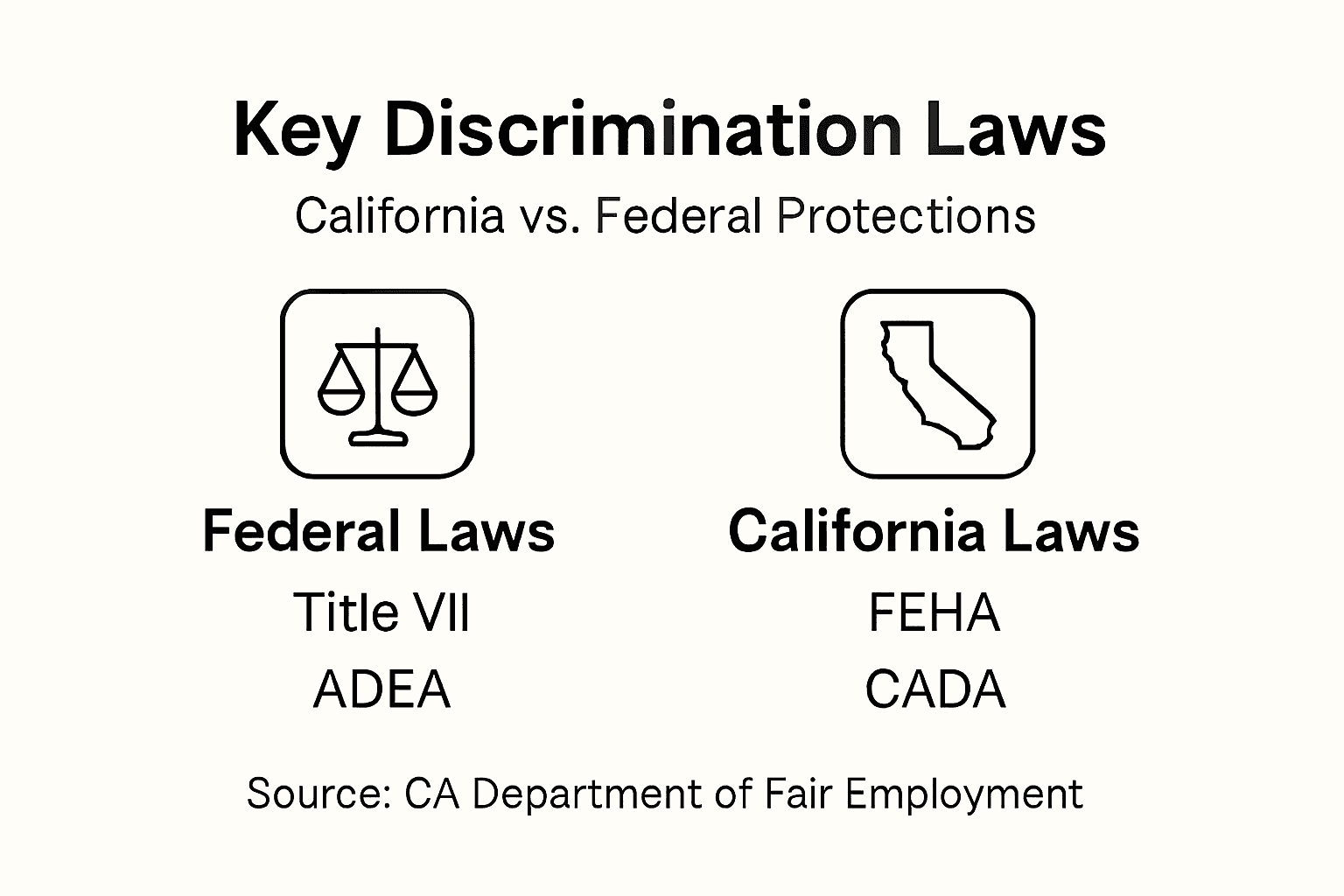
Here’s a comparison of how federal and California discrimination laws protect employees:
| Aspect | Federal Law Protections | California Law Protections |
|---|---|---|
| Minimum Employer Size | 15 employees for most statutes | 5 employees under FEHA |
| Covered Characteristics | Race, color, sex, religion, etc. | Broader list, including gender ID |
| Harassment Training | Not specifically required | Mandatory for many employers |
| Retaliation Protections | Protected for complaints | Stronger, including whistleblowers |
Pro tip: Keep detailed records of any potential discriminatory interactions, including dates, witnesses, and specific comments, as documentation can be crucial in substantiating legal claims.
Employee Rights, Legal Remedies, and Reporting
California employees have robust legal protections against workplace discrimination, with multiple avenues for addressing and resolving unfair treatment. Employee discrimination rights provide comprehensive mechanisms for workers to challenge and seek remedies for workplace violations, ensuring that individuals can defend themselves against unjust employment practices.
Key employee rights and reporting processes include:
- Right to File Complaints: Employees can submit discrimination claims to:
- California Civil Rights Department (CRD)
- Equal Employment Opportunity Commission (EEOC)
- Potential Legal Remedies:
- Lost wage compensation
- Job reinstatement
- Emotional distress damages
- Punitive damages
- Protection Against Retaliation: California law strictly prohibits employers from retaliating against workers who report discrimination
The legal process typically requires employees to document incidents carefully and follow specific administrative procedures. Workers must usually exhaust administrative remedies before pursuing litigation, which often involves obtaining a right-to-sue letter from state or federal agencies. This structured approach ensures that discrimination claims are thoroughly investigated and provides multiple opportunities for resolution before entering courtroom proceedings.
The following table summarizes the main types of evidence that can strengthen a workplace discrimination claim:
| Evidence Type | Example | Importance in Legal Claims |
|---|---|---|
| Written Documentation | Emails, memos, performance reviews | Establishes a timeline and motive |
| Witness Accounts | Coworker statements, supervisor | Supports claims of unfair treatment |
| Contemporaneous Notes | Incident logs with dates/details | Demonstrates ongoing conduct pattern |
Pro tip: Preserve all communication records, performance evaluations, and witness contact information when experiencing potential workplace discrimination, as comprehensive documentation strengthens legal claims.
Costs, Fee Structures, and Common Mistakes
Navigating the financial landscape of job discrimination legal representation requires understanding the various fee structures and potential costs involved. Discrimination lawyer costs typically follow several predictable models that can help employees make informed decisions about pursuing legal action.
Primary fee structures for discrimination lawyers include:
- Contingency Fee Arrangement:
- No upfront legal fees
- Lawyer receives 33% to 40% of settlement or award
- Minimal financial risk for the client
- Hourly Rate Model:
- Rates range from $300 to $500 per hour
- Requires consistent client payments
- More common in complex or uncertain cases
- Flat Fee Services:
- Predetermined cost for specific legal tasks
- Less common in discrimination cases
- Typically used for straightforward legal consultations
Employees should be aware of common mistakes that can undermine their discrimination claims. Critical errors include failing to document incidents thoroughly, missing crucial filing deadlines, neglecting administrative remedies, and selecting lawyers without specialized employment discrimination experience. These missteps can significantly reduce the likelihood of a successful legal outcome and potentially forfeit potential compensation.
Pro tip: Request a detailed fee agreement in writing and clarify all potential costs and payment structures before signing with a discrimination lawyer.
Protect Your Rights with Expert Job Discrimination Support
Facing job discrimination in California can be overwhelming and isolating. The article highlights how subtle and systemic unfair treatment affects your career, compensation, and work environment every day. If you have experienced disparate treatment, harassment, or retaliation remember you are not alone and the law protects you. Understanding your rights under California’s strong discrimination laws is the first step to reclaiming your workplace dignity.
At California Labor Law, we empower you with clear legal guidance based on proven employment statutes and practical advice on documenting incidents that matter. Don’t let confusion or fear keep you from getting justice. Take action now to protect your job and future by calling California Labor Law at 1-866-355-9991 and learn how to start defending your rights today.
Frequently Asked Questions
What is job discrimination?
Job discrimination occurs when an employer treats an employee unfairly based on protected characteristics such as race, gender, age, disability, or sexual orientation. This can happen in hiring, firing, promotions, compensation, and daily workplace interactions.
How can a job discrimination lawyer help me?
A job discrimination lawyer can provide legal consultations, help gather evidence, guide you through the complaint process, negotiate settlements, and pursue litigation if necessary. Their expertise is crucial in navigating complex discrimination claims.
What are the types of workplace discrimination recognized in California?
California recognizes several types of discrimination including disparate treatment, disparate impact, harassment, and retaliation. Each type has unique legal implications and may require different approaches to resolve the issues.
What legal protections do employees have against discrimination?
Employees have the right to file complaints with the California Civil Rights Department or the Equal Employment Opportunity Commission and seek remedies such as lost wages, job reinstatement, and protection against retaliation by their employers.
Recommended
- Understanding Workplace Discrimination Types and Impacts
- Impact of Discrimination Based on Age in California
- Understanding Workplace Harassment Laws in California
- How Trumps Immigration Enforcement Affects Latino Workers in California