




What are the Statute of Limitations for California Wrongful Termination?
Getting fired unfairly is tough, and knowing your rights matters even more when time is ticking. There is something most people miss: the window to take legal action can disappear fast. In some states you might have only 180 days to file a claim or you could have up to 3 years, depending on a few key details. That countdown can run out before you even know it began, and waiting too long means you could lose your shot at justice for good.
What is the Wrongful Termination Statute of Limitations?
A wrongful termination statute of limitations represents the legal time frame within which an employee can file a lawsuit against their employer for unlawful job dismissal. This critical legal concept determines how long workers have to take legal action after experiencing potentially illegal termination.
Legal Time Constraints for Filing Claims
The statute of limitations varies depending on the specific type of wrongful termination claim and applicable state or federal laws. According to Cornell Law School, these time limits are designed to ensure fair legal proceedings and prevent stale claims from surfacing years after an incident.
Typical time frames for wrongful termination claims can range from 180 days to 3 years, depending on several factors:
- Federal discrimination claims through the Equal Employment Opportunity Commission (EEOC)
- State level employment law violations
- Specific types of workplace misconduct
Factors Influencing Statute of Limitations
Multiple elements impact the precise duration for filing a wrongful termination lawsuit. Key considerations include:
- The nature of the termination (discriminatory, retaliatory, contractual breach)
- Whether the claim involves state or federal law
- The specific employment sector and type of violation
Employees should understand their complete rights in wrongful termination cases to ensure they do not miss critical filing deadlines. Waiting too long can permanently forfeit your ability to seek legal remedy for an unjust job loss.
To help you understand the factors that impact the wrongful termination statute of limitations, the following table summarizes key variables and their effects on filing deadlines.
| Factor | Impact on Statute of Limitations | Example |
|---|---|---|
| Type of Claim | Different claims have unique time frames | Discrimination vs. Retaliation |
| Applicable Law (State vs. Federal) | State and federal laws set varying limitations | EEOC (federal) vs. state law claims |
| Nature of Termination | The reason behind the firing can affect deadlines | Contract breach vs. discrimination |
| Discovery of Wrongful Action | Time may start when employee learns of the action | Hidden vs. obvious violations |
| Employment Sector | Special rules may apply in some industries | Private vs. public sector |
Comprehending these time limitations is crucial because once the statute of limitations expires, courts will typically dismiss the case without considering its merits. This underscores the importance of prompt legal action and consultation with employment law professionals who can guide you through the complex process of challenging an unlawful termination.
Why Does the Statute of Limitations Matter in Employment Disputes?
Statutes of limitations serve as critical legal safeguards that protect both employees and employers by establishing clear boundaries and time frames for resolving workplace disputes. These legal time constraints are not merely procedural technicalities but fundamental mechanisms ensuring fairness and preventing potential long-term legal uncertainties.
Preserving Evidence and Ensuring Timely Resolution
The statute of limitations plays a crucial role in maintaining the integrity of legal proceedings. As the Fair Labor Standards Act indicates, time-bound legal claims help preserve critical evidence and witness testimonies that might otherwise become unreliable or disappear over extended periods.
Key reasons why statutes of limitations are essential include:
- Protecting employers from indefinite legal vulnerability
- Ensuring evidence remains fresh and credible
- Encouraging prompt resolution of workplace conflicts
Legal and Practical Implications
Beyond procedural requirements, statutes of limitations have significant practical implications for employment disputes. When employees delay filing claims, they risk permanently losing their legal recourse. This potential forfeiture underscores the importance of understanding and respecting these time limitations.
Moreover, these legal time frames serve multiple purposes:
- Preventing stale claims with potentially degraded evidence
- Promoting workplace stability and legal predictability
- Balancing the interests of both employees and employers
Employees seeking legal representation in California wrongful termination cases must recognize that timing is everything. Missing a critical deadline can mean the difference between obtaining justice and having a valid claim completely dismissed.
Ultimately, statutes of limitations are not obstacles but essential mechanisms that ensure fair, timely, and effective resolution of workplace disputes. They compel both parties to address potential legal issues promptly and systematically, thereby maintaining a balanced and responsive employment legal framework.
How the Wrongful Termination Statute of Limitations Works
The wrongful termination statute of limitations operates as a complex legal mechanism that defines the precise window during which an employee can pursue legal action against an employer for unlawful job dismissal. Understanding its operational framework requires examining the intricate details of claim initiation, calculation, and potential exceptions.
Calculating the Time Frame
Statute of limitations calculation begins from a specific triggering event, typically the date of termination or the moment the employee becomes aware of the wrongful action. According to 29 U.S. Code 255, these time limits are not arbitrary but strategically designed to balance fairness between employees and employers.
Key elements in calculating the time frame include:
- The specific type of employment violation
- Whether the claim involves state or federal law
- The intentionality of the employer’s actions
Variations in Limitation Periods
Different types of wrongful termination claims have distinct limitation periods. Some claims might have shorter windows, while others provide more extended periods for legal action. Critical variations exist based on:
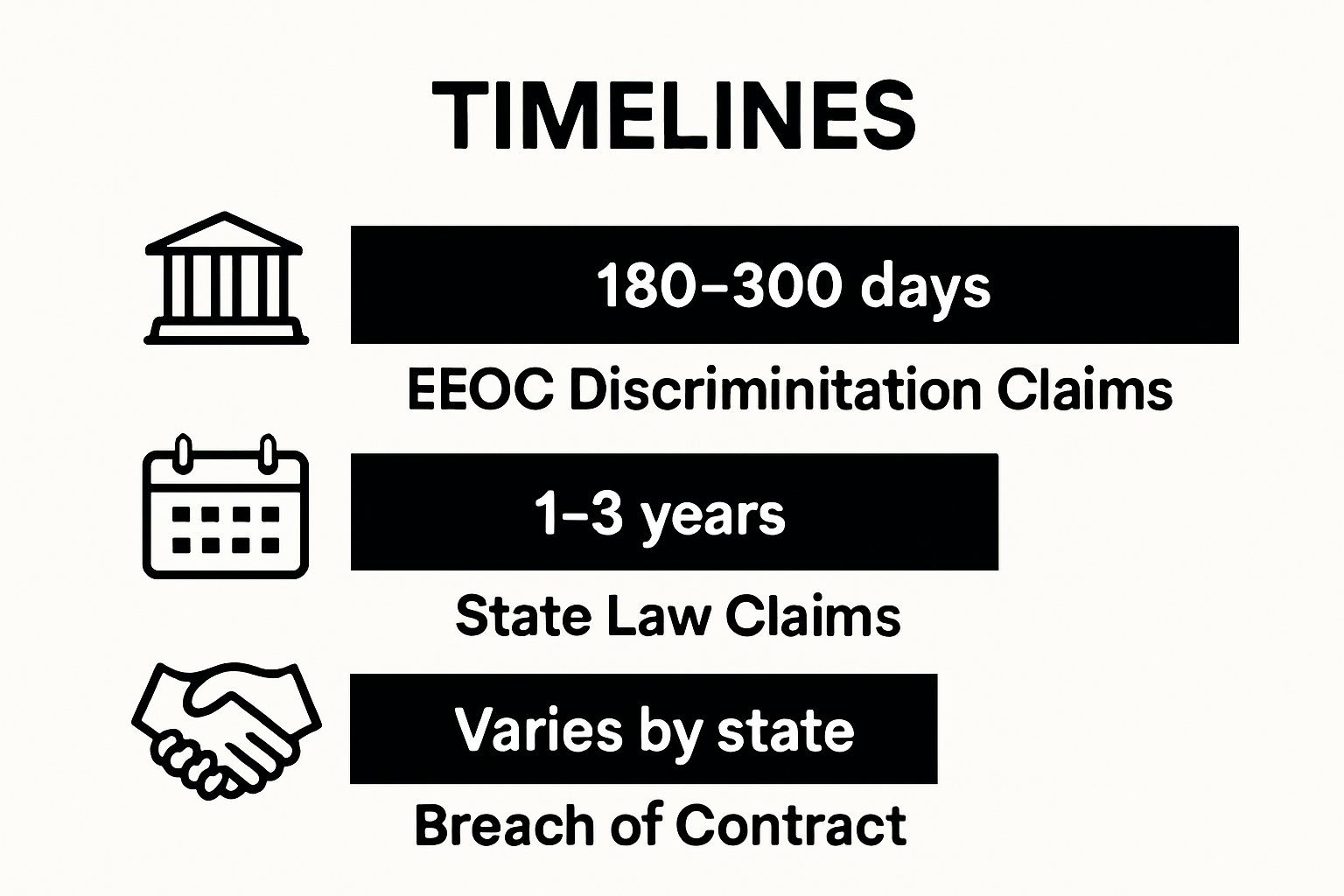
- Discrimination claims (typically 180 to 300 days)
- Retaliation claims
- Breach of employment contract disputes
Employees should check their wait time penalty options to understand how timing impacts their potential legal remedies. The complexity of these time frames underscores the importance of prompt and strategic legal consultation.
Below is a comparison table outlining common types of wrongful termination claims and their typical statute of limitations, helping you quickly see how your situation might be categorized.
| Type of Claim | Typical Statute of Limitations | Triggering Event |
|---|---|---|
| Discrimination (Federal) | 180-300 days | Date of termination or discovery |
| Retaliation | 180 days to 3 years | Date of adverse action |
| Breach of Contract | 2-3 years (varies by state) | Date of contract breach/termination |
| State Law Violations | 1-3 years | Date of incident/termination/discovery |
| Wage/Hour (FLSA) | 2-3 years | Date of wage violation or termination |
The statute of limitations is not just a procedural hurdle but a critical legal safeguard. It ensures that evidence remains fresh, witnesses are available, and both parties can effectively address workplace disputes within a reasonable timeframe. Employees must act swiftly and precisely, recognizing that delays can permanently extinguish their right to seek justice for wrongful termination.
Key Concepts in Wrongful Termination and Statute of Limitations
Wrongful termination and its associated legal time constraints represent a complex intersection of employment law that requires nuanced understanding. These legal principles protect employee rights while establishing clear boundaries for potential legal recourse against employers who violate workplace regulations.
Defining Wrongful Termination
Wrongful termination occurs when an employee is fired for illegal reasons that violate established employment laws or public policy. According to 29 U.S. Code 255, legal frameworks recognize several critical scenarios constituting wrongful termination:
- Discrimination based on protected characteristics
- Retaliation for reporting workplace violations
- Termination that breaches explicit employment contracts
- Firing an employee for exercising legal rights
Fundamental Legal Principles
Statute of limitations fundamentally serves as a legal time barrier that defines the window during which an employee can pursue legal action. The critical aspects include:
- Precise calculation of the legal time frame
- Recognition of different limitation periods for various claim types
- Understanding triggering events that initiate the limitation period
Employees seeking comprehensive insights can explore our California employment law blog for deeper understanding of these complex legal nuances. The interplay between wrongful termination claims and their associated time limitations requires careful navigation and strategic legal planning.

Ultimately, understanding these key concepts empowers employees to recognize potential workplace violations and take timely, informed action. The statute of limitations is not merely a procedural technicality but a crucial mechanism ensuring fair resolution of employment disputes while protecting both employee rights and employer interests.
Do Not Lose Your Chance to Act on Wrongful Termination
Are you worried about missing the tight deadlines explained in this article? The statute of limitations can rob you of your chance for justice if you wait too long. Many California workers struggle with the fear and confusion of when and how to file a claim for wrongful termination. Missing the filing window can mean permanent loss of your rights, as this article highlights.
Do not let uncertainty hold you back. Find real answers and tools that put you in control. Our website, California Labor Law, offers quick guides, legal calculators, and current law updates to help you understand your options right now. If you think you are owed lost wages or wait time penalties after being let go, start with our California wait time penalty resource for potential claims. Confused about your broader legal protections? Call us at 1-866-355-9991 to discuss your options today with a free wrongful termination consultation.
Frequently Asked Questions
What is the statute of limitations for wrongful termination claims?
The statute of limitations for wrongful termination claims can range from 180 days to 3 years, depending on the nature of the claim and applicable state or federal laws.
Why is the statute of limitations important in wrongful termination cases?
The statute of limitations is essential because it sets a deadline for filing claims, ensuring timely legal action and preserving evidence, which helps maintain the fairness of the legal process.
How do I calculate the time frame for filing a wrongful termination lawsuit?
The time frame typically begins from the date of termination or the moment the employee becomes aware of the wrongful action, influenced by the specific type of violation and applicable laws.
What happens if I miss the statute of limitations deadline?
If you miss the statute of limitations deadline, you may permanently lose your right to pursue legal action for wrongful termination, and the court will likely dismiss your case without considering its merits.