



California Required Rest and Meal Breaks 2026: Full Guide for Employees
Long shifts in California hotels and restaurants often leave workers struggling to fit in a real break, especially when management treats breaks as a favor instead of a right.
Clear protections exist under California law that go beyond federal standards, making it crucial for hospitality employees to understand how rest and meal break rights are legally enforced and compensated.
This guide gives you the clarity needed to spot illegal practices and document missed breaks so you can recover the wages you deserve.
Defining Rest and Meal Break Rights
Your right to breaks during your shift is one of the most misunderstood parts of California labor law, especially in hospitality where time moves fast and managers often treat breaks as optional favors rather than legal requirements. The reality is different. California provides stronger protections than federal law does, and understanding what you’re entitled to matters when you’re working long shifts in hotels, restaurants, or other service roles.
Let’s start with rest breaks. For every four hours worked (or even a major fraction of four hours), you get a paid 10-minute rest break. This break must be taken as close to the middle of each work period as possible, and your employer has to compensate you for this time.
Short rest breaks lasting 5 to 20 minutes are compensable work hours, meaning you get paid even though you’re technically not working.
The key word here is “paid”—you cannot use this time for personal tasks at home. Your employer must provide an actual break where you can step away from your duties.

Meal breaks work differently. You’re entitled to at least a 30-minute unpaid meal break for every five hours of work.
Unlike rest breaks, you don’t get paid for meal time, but your employer still has a legal obligation to provide the opportunity for you to take it. The break must be duty-free, meaning you cannot be required to work or monitor operations while eating.
In hospitality, this is crucial—you cannot be told to eat at your desk while answering phones or managing reservations. If the nature of your job makes it impossible to be relieved of duties (rare but possible in certain situations), a written agreement must explicitly address this.
Here’s what matters most: your employer must make these breaks available to you.
The law places the responsibility on management to schedule and allow breaks. If breaks are denied or delayed beyond what’s reasonable, your employer owes you one additional hour of wages for each day this violation occurs. This isn’t a small penalty.
If you work five days a week and never received your meal breaks, that’s five hours of extra pay per week—significant money that often goes unclaimed.
Pro tip: Keep a simple shift log noting dates when breaks were missed or cut short. This documentation becomes essential if you need to file a wage claim later, as it shows a pattern rather than isolated incidents.
To clarify the differences between rest and meal breaks under California law, see the table below:
| Aspect | Rest Breaks | Meal Breaks |
|---|---|---|
| Duration | 10 minutes (paid) | 30 minutes (unpaid) |
| Frequency | Every 4 hours worked | Every 5 hours worked |
| Compensation | Included in wages | Not included; duty-free |
| Location | Away from workstation | Must be relieved of duties |
| Waivers Allowed | Not permitted | Only by written agreement |
Required Break Durations and Waivers Explained
The specific minutes you get for breaks matter, and so does understanding when your employer can legally ask you to skip them. In hospitality, managers sometimes blur these lines, suggesting breaks are negotiable or optional when they legally are not. They’re required, period.
But there are specific situations where waivers exist, and knowing the difference keeps you from accidentally giving up rights you didn’t realize you had.
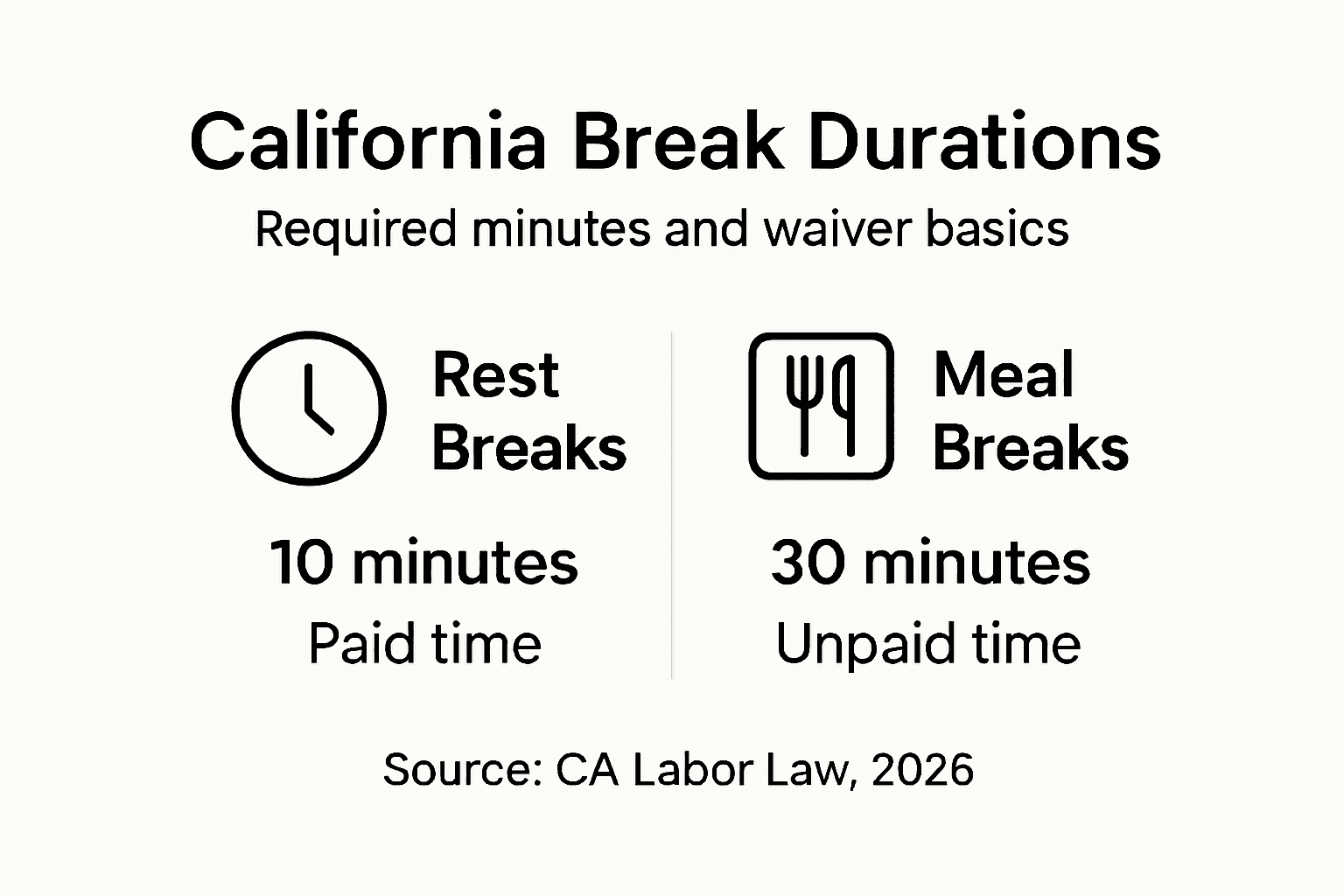
Rest breaks are straightforward: 10-minute paid breaks for every four hours worked or any major fraction of four hours. This means if you work four hours and one minute, you still get that full 10-minute break. The break should occur near the middle of your work period.
So if you’re working a four-hour shift, your break should ideally come around the two-hour mark, not at the end when it barely helps. With meal breaks, you need at least 30 minutes unpaid for every five hours of work.
Again, a major fraction counts—work five hours and one minute, and you’re entitled to the full 30-minute meal break. If you work over 10 hours in a single day, you get a second meal break, unless that second break is waived by mutual written consent.
Now here’s where waivers come in, and this is critical for hospitality workers who often encounter pressure around this. Meal periods may be waived by mutual consent when total work hours are six or less. This means if you’re scheduled for a short six-hour shift, your employer can propose skipping the meal break if you agree in writing.
But “mutual consent” is the key phrase—your employer cannot simply announce that breaks are waived. You must actively agree, and that agreement should be documented.
Unfortunately, many hospitality managers treat this as a one-sided decision, telling staff “we’re skipping lunch today” without actual consent. That’s illegal.
One more scenario affects hospitality workers specifically: on-duty meal periods. If your job requires you to stay at your work location during your meal break—perhaps covering the front desk while eating or monitoring the restaurant floor—that time must be paid.
You cannot be asked to work through lunch unpaid just because you’re technically eating on site. If an on-duty meal period is arranged, it must be a written mutual agreement, and you must receive compensation for that time. This protects you from situations where managers claim you “chose” to eat at your station while remaining responsible for customers or operations.
Pro tip: Request written confirmation of any agreed-upon break waivers from your manager or HR department, and keep copies in your personal files separate from your workplace records for safety.
Employer Obligations and Common Violations
Your employer doesn’t get to decide whether breaks are optional. California law places specific obligations on management, and when they fail to meet these obligations, it becomes a wage violation. Understanding what your employer must do—and what they cannot do—is the foundation for recognizing when something illegal is happening on your shift.
Employers have one core obligation: authorize and permit rest periods of at least ten minutes for every four hours worked. This means management must actually schedule breaks, not just vaguely allow them. If you work a four-hour shift and never get time away from your station, that’s a violation. If you work eight hours and get only one 10-minute break instead of two, that’s a violation. The break must happen, and it must be paid.
Similarly, your employer must provide a 30-minute unpaid meal break for every five hours worked. The requirement isn’t that breaks “be available”—it’s that they must be “authorized and permitted,” meaning actively scheduled and facilitated.
Common violations in hospitality happen in predictable patterns. Denying breaks, requiring employees to work through breaks, and failing to compensate missed breaks are the most frequent violations.
A manager might claim you “didn’t have time” for a break, or that you “chose” to skip it. Neither excuse matters legally. Your employer has an affirmative duty to make breaks happen. Some managers create situations where breaks appear impossible—understaffing your section so nobody can cover you, or scheduling breaks during peak customer times.
These tactics violate the law. You cannot be disciplined, pressured, or made to feel unwelcome for taking legally required breaks. Retaliation of any kind is illegal.
Another violation occurs when employers require you to remain “on call” during meal breaks. If you’re eating at your desk but still responsible for answering phones or helping customers, that’s an on-duty meal period that must be compensated. You cannot be expected to monitor operations while eating unpaid.
Understanding what qualifies as wage theft matters here—many hospitality workers don’t realize that uncompensated time spent managing duties while eating counts as stolen wages.
The financial consequences for employers are significant. For each day breaks are missed, employers owe you one additional hour of wages at your regular rate. If you work six days a week without meal breaks, that’s six hours of extra pay per week. Violations often accumulate quickly, and penalties compound.
Pro tip: Create a simple calendar or phone note documenting break violations as they occur, including the date, time, and specific circumstance (such as “told to skip lunch to cover front desk”), which strengthens any future wage claim.
Penalties for Missed or Denied Breaks
When your employer denies you breaks, they don’t just inconvenience you. They owe you money. This is where California law gets specific and powerful for workers.
The penalty structure is straightforward, and it adds up fast, especially in hospitality where understaffing and missed breaks happen frequently. Understanding the financial consequences helps you recognize whether unpaid wages are accumulating in your current position.
Here is the core penalty: employers must pay one additional hour of pay at regular rate for each workday breaks were not provided. This is premium pay, separate from your regular wages.
If you work a ten-hour shift and your employer fails to give you two required rest breaks and one meal break, that is three hours of premium pay owed to you. If this happens across a five-day work week, that is 15 hours of additional compensation.
For a hospitality worker earning $16 per hour, that is $240 per week. Over a year, assuming consistent violations, that reaches approximately $12,480 in unpaid wages.
The critical detail many workers miss: this premium pay is not counted toward overtime calculations. You cannot be forced to work overtime and then have the employer claim that the break premium satisfied overtime requirements. These are separate wage obligations.
Additionally, failure to timely pay wages including break premium pay can result in additional penalties under California Labor Code. This means if your employer withholds break compensation, you may be owed not just the premium hours but further penalties for late payment.
The statute of limitations for claiming unpaid break premium is three years. This means if you were denied breaks throughout 2023, 2024, and 2025, you can file a claim seeking compensation for all three years of violations. Your employer cannot avoid liability by claiming violations happened too long ago, unless more than three years have passed.
However, certain circumstances may extend or shorten this timeline, so documentation of when violations occurred matters significantly.
What makes this penalty structure powerful is its cumulative nature. Employers cannot simply pay a flat fine and move forward. Each day of violation creates a new wage obligation.
If your employer systematically denies breaks to an entire shift, they may owe compensation to multiple workers simultaneously, creating substantial financial exposure. This is why some employers attempt to pressure workers into signing waiver documents or avoid scheduling breaks altogether.
Pro tip: Track the exact date and time of each missed or shortened break for at least three months, noting how long the break should have been, then calculate your owed premium pay by multiplying the number of violation days by one hour times your hourly rate.
Industry-Specific Exceptions and Special Cases
Not every California worker gets the same break rules. Certain industries operate under different legal frameworks, and hospitality professionals need to understand whether your specific job falls into an exception category.
The bad news: some legitimate exceptions exist.
The good news: even when exceptions apply, you still have protections, and employers often misuse these exceptions to deny breaks they are legally required to provide.
The motion picture industry operates under its own wage order with distinct meal break requirements. If you work on film or television sets, your break entitlements differ from standard hospitality rules.
Construction, drilling, logging, and mining industries also have exceptions because the nature of their work makes traditional break scheduling impractical. In these sectors, rest breaks may be staggered or skipped temporarily to maintain continuous operations, but employers must compensate employees for missed breaks.
This is the critical point: an exception to scheduling breaks does not eliminate your right to compensation.
If your job requires continuous operation and breaks cannot be taken on schedule, your employer owes you premium pay for each missed break.
Certain hospitality workers may fall into specialized categories. Employees in 24-hour residential care facilities, for instance, have different break rules because someone must always be present. Performers engaged in strenuous physical activity—think dancers, swimmers, or skaters performing continuously—may have modified break requirements.
However, these exceptions apply only to specific worker groups defined by California Industrial Welfare Commission Wage Orders, and employers frequently overreach by claiming exceptions that do not actually apply to their workers. A hotel front desk clerk cannot claim the 24-hour residential care exception. A restaurant kitchen worker cannot claim the performer exception.
On-duty meal periods represent another special case relevant to hospitality. If your job genuinely prevents you from being relieved of duties during lunch—for example, you must monitor a security system or manage an emergency—your employer may require an on-duty meal period. This is legal only if a written agreement exists and the time is paid.
Many hospitality managers claim this exception when it does not apply. Being busy during lunch is not the same as being unable to be relieved. Understaffing is not a legal reason to deny breaks. Your employer must ensure coverage exists to relieve you from duties.
Pro tip: If your employer claims your job falls under an industry exception, request written documentation showing the specific exception and how it applies to your position, then verify the claim against California Department of Industrial Relations wage orders.
Here is a quick reference summarizing major exceptions and special cases in break rules for California workers:
| Industry/Role | Break Scheduling Exception | Compensation Requirement |
|---|---|---|
| Motion picture/film sets | Distinct break rules apply | Missed breaks must be paid |
| Construction & mining | Breaks may be staggered | Premium pay for missed breaks |
| 24-hour residential care staff | Shift-specific break rules | Compensation still required |
| Performers (athletes/dancers) | Modified break provisions | Defined by wage orders |
| Hospitality with on-duty meals | Must be in writing, paid | No waiver without documentation |
Know Your Break Rights and Protect Your Wages Today
Understanding California rest and meal break laws is critical for every hospitality worker facing the challenge of denied or shortened breaks.
If you have ever been pressured to skip breaks, worked through unpaid meal periods, or felt uncertain about your legal rights to rest and meal times, you are not alone.
Get support tailored to your situation by exploring our comprehensive guides and legal tools at California Labor Law. You can use our calculators to estimate unpaid break premiums and learn how to take action against wage theft.
Don’t wait for violations to continue — knowing your rights and seeking help now can make all the difference. Call 1-866-355-9991 for a free rest and meal break violation consultation to empower yourself with knowledge and connect with advocates ready to assist you through every step.
Frequently Asked Questions
What are my rights regarding rest breaks in California?
In California, employees are entitled to a paid 10-minute rest break for every four hours worked or a major fraction thereof. Employers must schedule these breaks, and employees must be compensated for this time even if they are not performing work.
How long is the required meal break for employees in California?
Employees in California are entitled to at least a 30-minute unpaid meal break for every five hours worked. This break must be duty-free, meaning employees cannot be required to work or monitor operations during this time.
What happens if my employer denies or delays my breaks?
If your employer denies or delays your required breaks, they owe you an additional hour of pay for each day that breaks are not provided. This applies whether the breaks are rest or meal breaks.
Can my employer require me to waive my meal break?
Meal breaks can only be waived by mutual written consent when total work hours are six or less. Employers cannot simply announce that breaks are waived; an active agreement from the employee is necessary.